
Content marketing
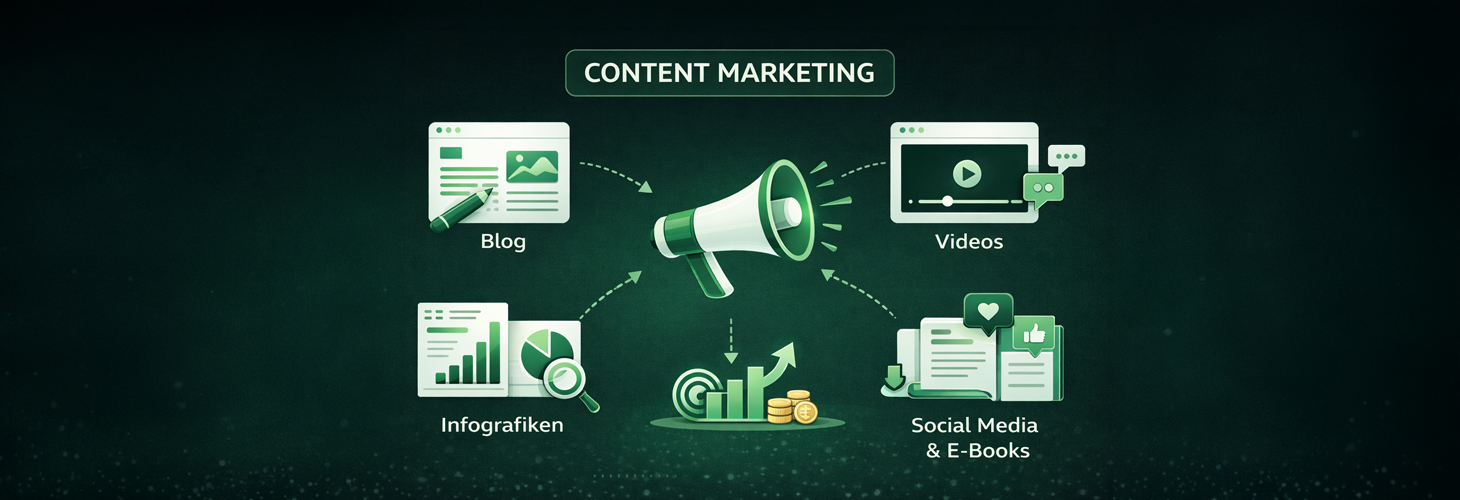
Content marketing is a strategic approach that doesn't promote products, services and companies with direct advertising, but wins and retains the target group with helpful content. Content should answer questions, solve problems, entertain and spark interest in further content. At the end there is a clear business goal: selling products, generating leads, building a loyal customer base or strengthening the brand. Search engines like Google place more and more value on high-quality, helpful content – from the Panda update, which targeted low-quality content, to the helpful content system. This makes content marketing closely intertwined with search engine optimisation and part of every SEO strategy.
Versatile formats in content marketing
Text is the classic form in content marketing. But if you really want to make an impression, you use the full range – images, videos and other formats. These include:
SEO texts and editorial articles (e.g. in a blog)
Images
Videos and clips
Infographics, tables and statistics
Podcasts
Webinars
E-books and white papers
Newsletters
Product tests and reviews
Which formats are suitable depends on the industry and target group – and on whether it is B2C or B2B content marketing.
User-generated content: customers create content
Another form is user-generated content – content created by users themselves, such as reviews, photos, comments or posts in forums and social networks. The advantage: the target group engages actively with the company and product and contributes its own experiences. Product reviews in particular create additional trust among other potential buyers.
Seize the opportunity of content marketing: define a goal
As with every online marketing strategy, content marketing needs a goal. This can be winning new customers, retaining existing ones, improving the company's image or building your own brand. Smaller companies and online shops in particular can use content marketing to establish themselves in the market. A craft business that regularly reports on materials and techniques builds up expertise this way. An online shop can retain customers in the long term with buying guides, care instructions, size guides or comparisons – whether for cleaning products or bicycle accessories. A guide or magazine section in the shop is particularly well suited to addressing long-tail search queries and typical customer questions. Good content is an important signal for Google – especially when users actually find what they are looking for and don't bounce back to the search results. Increasingly, such content is also used as a source by AI systems such as ChatGPT or AI Overviews.
What matters is that goal, strategy and planning are clear from the start. Companies should answer questions about objectives, target group, tone, format and distribution. An editorial calendar then provides an overview and a timeframe that everyone involved can follow.
Measuring the success of content
Success is measured against the goals set at the outset. These result in metrics such as organic traffic, rankings, conversion rate, revenue from content entry points, leads or interactions on social networks. What matters is that content doesn't just generate reach but contributes measurably to the business.
The future of content marketing
“Content is king” is a well-known saying in online marketing – and it applies more than ever. Content marketing takes many forms: besides evergreen content (permanently relevant content), snackable content (quickly consumable content) matters, for example for social media. Video, podcasts and webinars continue to gain importance. With generative AI, content can be produced faster – which makes genuine expertise, first-hand experience and proprietary data that stand out from interchangeable AI text all the more important. If you want to stay ahead, you should review your content marketing regularly, because content and search engine optimisation have long since merged.