
Dofollow / Nofollow
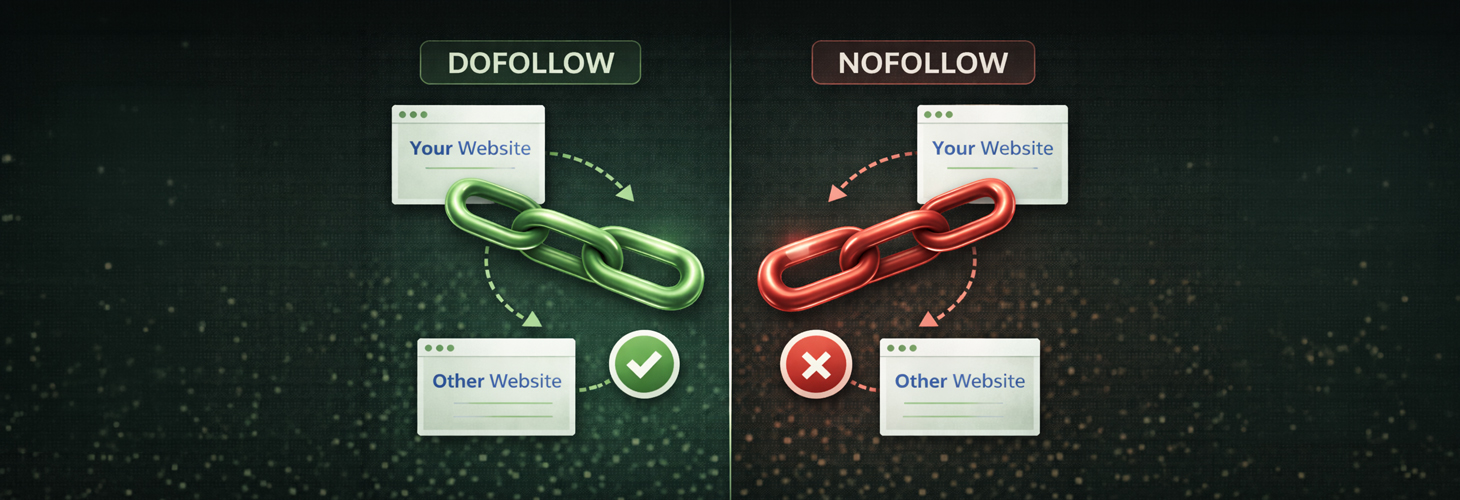
Backlinks are important for a website's ranking and are part of standard SEO activities. Google appreciates a well-structured and natural link profile of a website. However, the prerequisite is that link building does not arise from dubious measures: There was a time when the impact of link spam postings in internet forums and blogs was so significant that the search engine Google followed up "Dofollow" with "Nofollow." The reasons for this situation are backlinks, references to websites that until that time were referred to as "Dofollow." The search engine crawler, in this case the Googlebot, was thus conveyed to follow the link to the external website and to include it in the evaluation of link popularity. The "Dofollow" link perfectly aligns with the original concept of the World Wide Web, where pages interconnect and consequently "recommend" each other. As a result, both visitors and web crawlers reach an external website considered interesting through linking.
The problem with the spam-like use of "Dofollow" backlinks
When websites that operate in the same thematic environment provide a useful added value to visitors through corresponding follow-links and, furthermore, allow search engine crawlers to search and index the Internet, this is fundamentally good. However, there are always attempts to manipulate within the framework of search engine optimization. The existing possibilities to obtain valuable "dofollow" backlinks for one's own site are driven to such extremes that they are considered spam. And because blogs and internet forums—where anyone can register and post content—are particularly suitable for these spam techniques, there were numerous individuals in these areas who could insert "dofollow" links into their posts and thus build backlinks for a website. Even though forum and blog operators do not profit from worthless content, it was the search engine Google that introduced the "nofollow" attribute in 2005 as a supplement to the follow attribute to differentiate between useful and useless references. Despite the "nofollow" attribute, which is marked in the HTML source code of a website with rel="nofollow", visitors and search engines can follow the link to a page, but the linking will no longer be incorporated into the website's link popularity and influence the ranking. However, this also reduces the risk of ranking downgrades that result from a large number of bad "dofollow" backlinks.
Is "Nofollow" bad for search engine optimization?
The fact that "Dofollow" links from internet forums and blog comments were no longer useful for building high link popularity didn't sit well with search engine optimizers and webmasters at all. Criticism arose that the evaluation of websites would be distorted as a result. A few years after the introduction of the "Nofollow" attribute, the excitement has subsided somewhat, as these types of links can also be useful for search engine optimization. Links with the "Nofollow" attribute, like "Dofollow" references, are part of a natural backlink profile of a website, with varying proportions depending on the industry. At the same time, the usefulness of "Nofollow" links depends on the linking website: low or high authority or social media. The latter, in particular, has become interesting for the SEO industry in recent years, because so-called social signals—information from social networks (likes, retweets, comments)—are not only meant to influence a site's ranking but also increase user attention and extend the reach of content. And if this content is "rewarded" by external websites with a "Dofollow" link, the "Nofollow" link still holds value for search engine optimization.
"Nofollow" and "Dofollow link", "user generated" and "sponsored": the linkbuilding mix
Later, additional tags for links were added to the "Dofollow" and "Nofollow" references: "ugc" and "sponsored". The former is an attribute intended to mark User Generated Content on a page. This is particularly useful if you have a comment function on your website. For comments containing a link, the "ugc" meta tag can be used to indicate to Google that this is content created by a user. The "sponsored" meta tag, on the other hand, is used when engaging in link buying. Link buying is not a highly regarded link-building method by Google, but if the indication is set, there is no risk of penalty from the search engine. In general, it can be said that "Nofollow" links do not replace the need to pay attention to link quality and avoid so-called Bad Neighborhoods. Just because bad backlinks are no longer set to "Dofollow" doesn't mean the work is done. Therefore, it is more about the right mix of links: Dofollow, Nofollow, sponsored, and ugc must interlink within a natural link profile.