Shopify SEO agency: visibility and revenue for your online store
Make your Shopify store less dependent on paid traffic: With SEO, GEO, content built around search intent and our own development team, arboro brings more relevant clicks from organic search, AI Overviews and other AI systems into your e-commerce business.

When good products generate too little revenue on Google
Your Shopify store has grown over the years – or has just moved over from another shop system. Product range, checkout and processes are running, yet organic search is falling short of expectations. Competitors rank ahead of you for important queries, while your own product and category pages are barely visible. Especially after a migration, this is rarely a coincidence: URLs, content and internal linking have changed, and Google is re-evaluating the store.
arboro has supported e-commerce companies in development and consulting for 17 years – and with Shopify since 2019. As a Shopify Partner, we develop, maintain and optimize online stores ourselves. Our teams have also worked with Shopware systems for many years. That helps us identify typical causes quickly, prioritize them by business potential and implement the necessary changes ourselves – especially in times of AI Overviews and other AI systems.





As a full-service agency, we put recommendations into action
An SEO audit can reveal weaknesses in detail. An important category page needs a different structure? An app is costing load time? There is no matching landing page for a relevant keyword?
However, value is only created when the audit findings lead to clear priorities and then to clean implementation. Recommendations alone are often not enough.
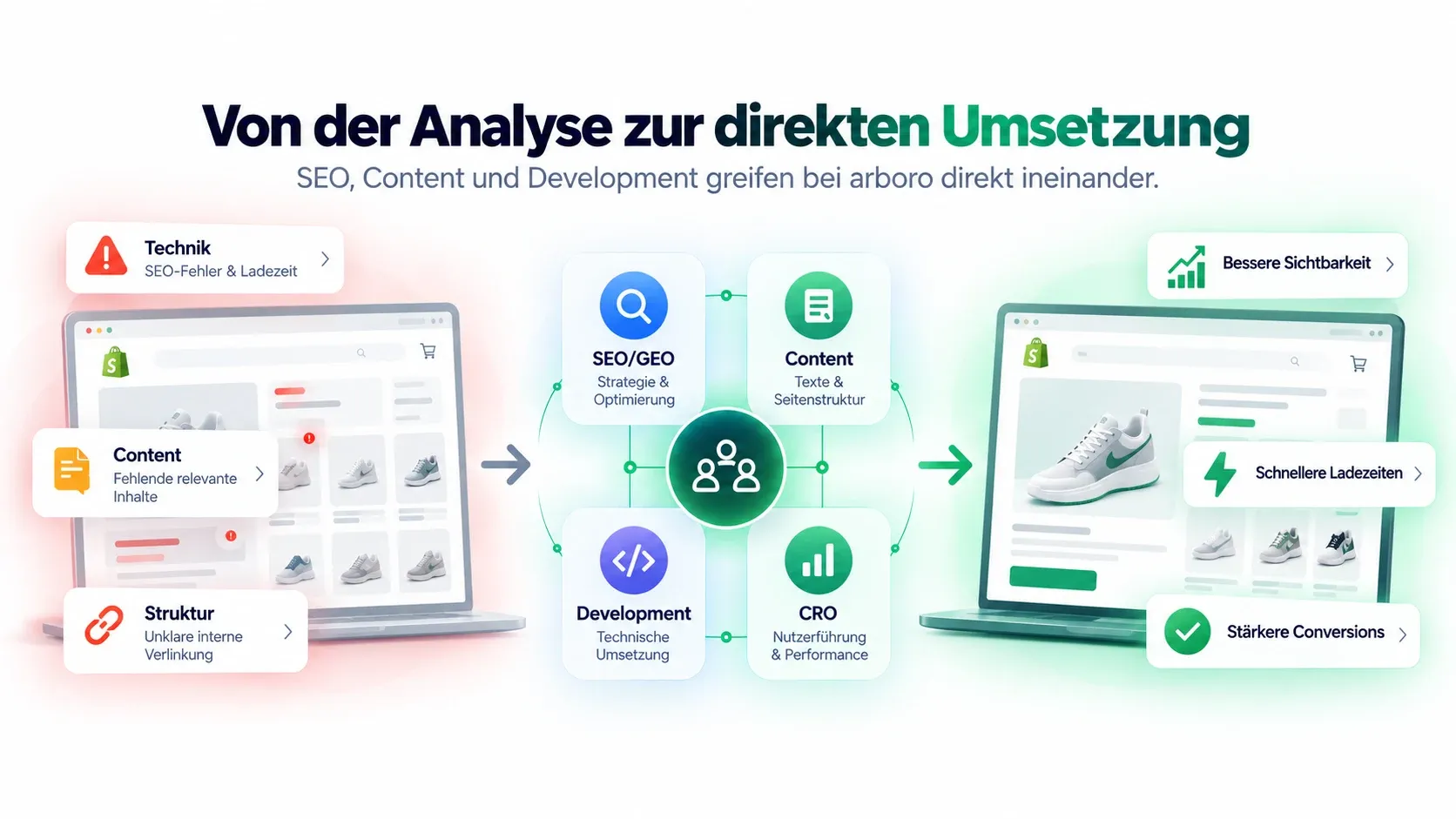
At arboro, technical recommendations do not have to be handed over to an external developer first. As a full-service agency, SEO/GEO, content, development and conversion optimization work under one roof. If the theme needs adjusting, our development team takes care of it. If a relevant landing page is missing, or content that better matches and understands your audience's search intent, the content and SEO teams step in together right away.
This way, the strategy does not get stuck in the audit. And you do not have to mediate between several service providers. That saves coordination effort and valuable time.
When is Shopify SEO support worth it?
A Shopify SEO agency usually becomes interesting for e-commerce companies when organic growth and sales fall short. Clients often come to us whose marketing teams know their products and target audience inside out but cannot free up enough time for technical analysis. Or the existing agency delivers recommendations but cannot implement changes to the online store itself. Or the store has grown so fast and so much that content, site structure and search intent no longer fit together cleanly.
Before internationalization, a relaunch or major range expansions, a systematic look at strategy and technical implementation also pays off. The earlier Shopify SEO is factored into such decisions, the less needs to be corrected later.
arboro can get involved at different depths: as a strategic sparring partner for your team or with full implementation including content strategy, content creation and development.
Where organic potential gets lost in Shopify stores
Shopify provides a good technical foundation but follows its own system logic. If you know it, you can avoid many problems early on. If you ignore it, you quickly create unnecessary URLs, weak internal linking or slow templates.
Do search engines find the right pages?
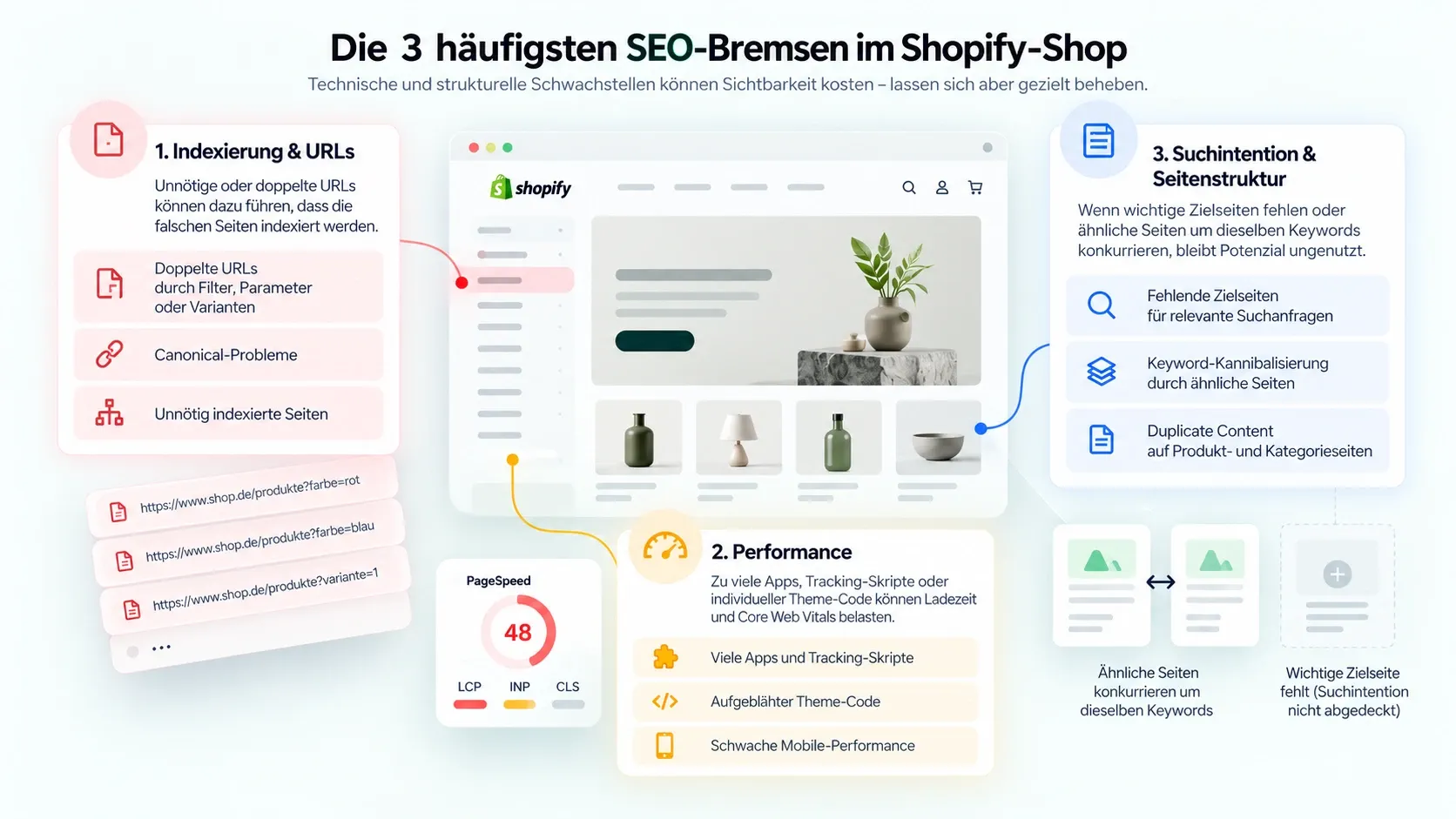
Product variants, filters, parameters and apps can create additional URLs. We check what Google crawls and indexes, how canonical tags are set and whether redirects work properly. The goal is not to get as many URLs as possible into the index. What matters are store pages that serve a specific search intent.
In a Shopify store, category pages are technically represented by collections. Here, too, we look at which pages cover their own demand and where several URLs needlessly compete for the same rankings.
Is the online store technically fast enough?
Apps, tracking and custom theme code accumulate over time. This can weigh on performance, especially in mobile SEO. We analyze Core Web Vitals, structured data, mobile performance and technical dependencies. If a problem shows up in the system, our developers can address it directly. Technical SEO does not end up as a ticket waiting with an external service provider.
Is there a matching landing page for relevant queries?
Sometimes the traffic problem is not on an existing page. Sometimes the landing page is simply missing. Then, for example, a magazine article ranks for a purchase-oriented search intent, or two similar pages compete with each other. Elsewhere, almost identical content exists although only one page is needed.
Together, we can avoid keyword cannibalization and duplicate content from the start. We group search queries by intent and check which page should serve them: product, category, landing page, guide or, in B2B, a solution or industry page. For more visibility and better signals on Google.
The 5 typical Shopify SEO mistakes – and how arboro fixes them
Shopify takes a lot of technical work off your hands: canonicals, sitemap and robots.txt are built in. Depending on theme, apps and store structure, some system quirks can still slow down organic visibility. arboro checks which of them actually apply to your store – and fixes them through configuration, content or targeted changes to the theme code.
1. Collection URLs direct internal links to secondary addresses
Many themes link products from collections via paths like /collections/women/products/sneaker. The canonical points to /products/sneaker – but whether Google adopts the intended URL and how much crawling goes to secondary addresses depends on the theme.
Solution: Review of internal product links and, where necessary, adjustments in the Liquid code so the store consistently links to the canonical product URL.
Business impact: Google crawls and evaluates the product pages that are meant to sell – not their duplicates.
2. Reflecting the category hierarchy despite a fixed URL structure
Shopify prescribes /collections/, /products/, /pages/ and /blogs/. Subcategories cannot be nested in the URL, so the range logic has to become clear through navigation, breadcrumbs and internal links.
Solution: Dedicated collections with descriptive handles wherever a subcategory has its own search demand – for example /collections/womens-shoes-small-sizes-sneakers. Nested navigation, breadcrumbs with structured data and internal links map the hierarchy.
Business impact: Customers searching specifically for a subcategory land directly on the right page – instead of with a competitor.
3. Variants, filters and tag pages can bloat the index
Parameters such as ?variant=, filter URLs, tag pages and default pages like /collections/all can quickly create many indexable addresses without any search demand of their own.
Solution: Clean canonical and noindex logic, adjustments in robots.txt.liquid and dedicated landing pages only for variants people actually search for.
Business impact: Crawling and link equity concentrate on the categories and products that generate revenue.
4. App leftovers in the theme slow down load time and Core Web Vitals
Uninstalled apps often leave snippets, scripts and CSS behind in the Liquid theme. Every new app loads additional files – mobile LCP and INP suffer most.
Solution: Theme audit, removal of orphaned app code and deferred loading of third-party scripts by arboro's developers.
Business impact: Faster pages improve conversion – for organic and paid traffic alike.
5. Product data and structured data incomplete or inconsistent
Many standard themes only provide basic product markup. Brand, GTIN, shipping costs, return policies or reviews are missing or do not match the information visible in the store.
Solution: Extending the JSON-LD with Product, Offer, shipping and return details, breadcrumbs and organization data – aligned with the visible content.
Business impact: Better conditions for search results showing price and availability – and product information that search engines and AI systems can clearly attribute.
Our Shopify SEO services: from audit to ongoing support
Not every store needs the same package. A B2C store with a few hundred products needs a different strategy than a B2B provider with complex solutions. That is why we put together the measures based on your starting point and business model.
Phase 1: Technical Shopify SEO audit and strategy
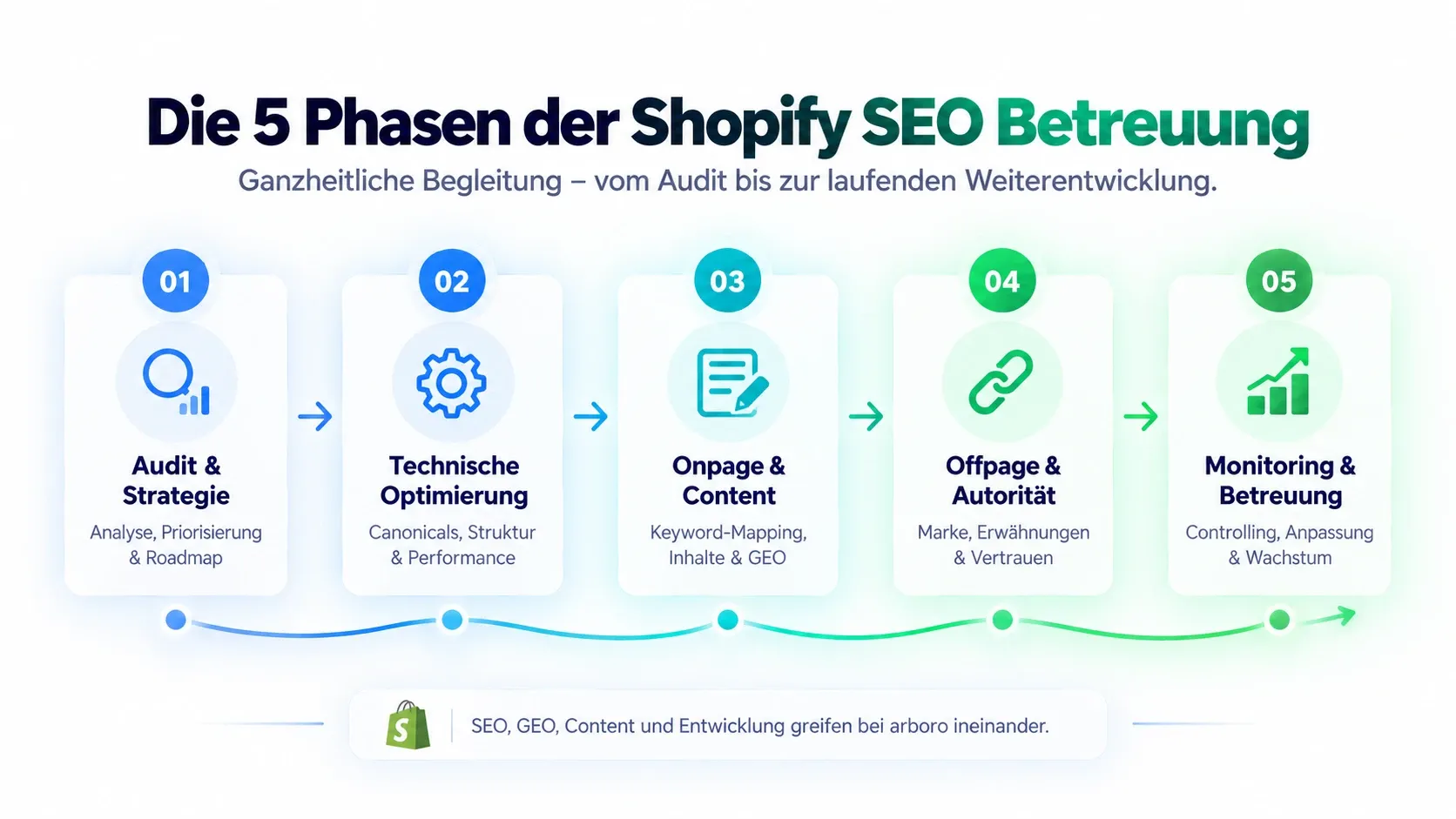
It all starts with a status check. We examine the technical condition of your online store, current rankings and search queries, and include data from Google Search Console and Google Analytics. The result is a roadmap that is not sorted by the number of issues found. We prioritize by what is holding back growth and where the effort pays off for you economically.
Want a free SEO check-up? Schedule an initial call
Phase 2: Technical optimization directly in the system
Canonicals, redirects, structured data, theme adjustments or load times: many measures can be implemented effectively when SEO and development work together.
Our developers can implement the technical changes directly in the shop system. That shortens the path from analysis to go-live – and reduces misunderstandings during handovers.
Phase 3: On-page and content optimization
A good SEO foundation consists of keyword research and clear keyword mapping: Which topics does your target audience search for, which search intents lie behind them and which page should rank for them – category, product or rather the magazine? Thorough research is essential for successful Shopify SEO. This way, we avoid several pages competing for the same terms or important queries being overlooked entirely and performance being wasted.
On-page optimization builds on this. Meta data should encourage clicks, headings should provide orientation and internal links should deliberately strengthen important pages. Product information and editorial content must answer what users want to know before making a purchase decision, while adding value and strengthening trust in your brand.
With AI Overviews, ChatGPT or Perplexity, there is an additional requirement: content should be structured so precisely that LLMs (large language models) can clearly understand statements, products, brands and use cases. Good SEO is the signpost for successful GEO – arboro delivers both.
Phase 4: Authority, off-page and digital brand
In highly competitive markets, good on-page work alone is often not enough. That is why arboro also includes backlink building, brand strength and external signals. Depending on the competition, white-hat link building and relevant mentions can help build trust and authority. With GEO in mind, this area is becoming increasingly important: AI systems do not form their view of a brand solely from its own website.
Phase 5: Ongoing SEO support
An online store is constantly changing. New products are added, apps interfere with technical processes or your target audience's search behavior shifts.
In ongoing Shopify support, we monitor rankings, organic traffic, indexing, changes in shopping carts and the development of AI systems. At arboro, we flexibly adjust the roadmap agreed with you when data shows a stronger lever.
New store or relaunch? SEO should have a seat at the table before go-live
Many problems can be corrected later. It is easier not to build them in at all.
Building a Shopify store with an SEO foundation from the start
When arboro develops a new Shopify store, organic search can already be considered in the concept phase. Which pages does the store need for relevant queries? How should products be structured sensibly? What requirements must templates, internal linking and structured data meet?
This way, the site architecture is not based solely on product range and design. It also takes into account how potential customers search and what information they need before placing an order or making an inquiry.
Don't leave rankings behind during a relaunch
During a relaunch or migration, URLs, content and internal links often change at the same time. If existing rankings are not taken into account, visibility built up over years can be lost.
Before go-live, we record relevant URLs and rankings, create the redirect mapping and check which content needs to be carried over. After the switch, we monitor indexing and organic performance. A relaunch should move the store forward – not send it back to square one on Google.
Shopify reference: Horsch-Shop
For 75 years and three generations, Felix Horsch has stood for women's and men's shoes in large and small sizes – online in the shop and on site at the Open Warehouse in Stuttgart's West End. arboro has supported the online store across three shop systems.
What arboro implemented:
Felix Horsch, Horsch-Shop
“arboro built our shop on Shopware 4, then Shopware 5, and then supported us in the switch to Shopify. For us as a family business, it was crucial that our customers can still find us on Google and in AI search after the move.”
See it live: horsch-shop.de

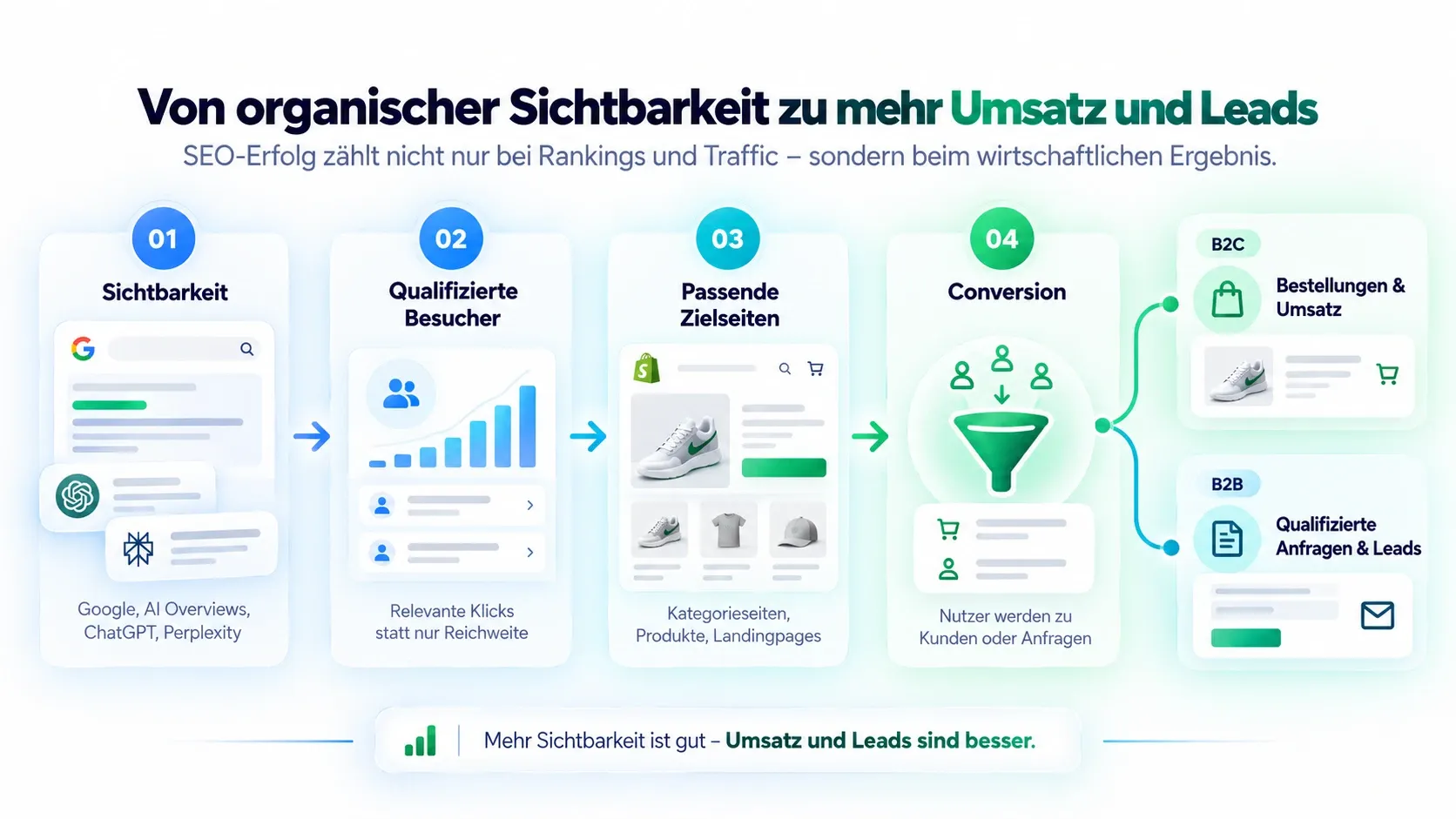
More traffic is good. Revenue and leads are better.
More visibility alone says little about whether a measure works commercially.
For a B2C store, we therefore look at which purchase-oriented pages gain more organic visitors and whether they lead to orders. In B2B, a smaller increase in traffic can be far more valuable if it brings qualified inquiries for relevant products or solutions.
Negative signals help too. If traffic rises but users do not buy, our analysis does not stop at rankings. Then it is worth looking at the offer, user guidance or conversion.
This way, SEO is not judged by as many green arrows as possible, but by what organic search contributes to the business.
What does professional Shopify SEO cost?
At arboro, you see the prices up front – not after three preliminary meetings. The scope depends on product range, markets and technical starting point.
Free initial call
30 minutes with a senior expert: You describe your situation and goals, and together you clarify where SEO and GEO should start for your store – and whether an SEO check-up makes sense.
Investment: free of charge
Free SEO check-up
An expert analysis of your store with around eight hours of work: technology, content, competition and visibility in Google and AI search. You receive a well-founded assessment and a recommendation. Whether the check-up makes sense for your store is clarified in the initial call. If you work with arboro, it serves as the diagnosis for the start.
Investment: free and non-binding for qualified online stores (value €990)
Detailed Shopify SEO audit
An audit of more than 70 pages, individually prepared by senior experts: technical analysis, recommendations prioritized by revenue impact, Core Web Vitals and competitor check. You discuss the results together with the experts in a Microsoft Teams call – as a roadmap for your team or for implementation by arboro.
Investment: €1,750 – fully credited when you commission further work
One-time technical Shopify SEO optimization
Canonicals, indexing, structured data, theme performance and internal linking – implemented directly in the store by arboro's developers.
Investment: from €3,500
Duration: 4–6 weeks
Ongoing SEO & GEO support
Technical optimization, content creation, ranking monitoring, GEO and conversion optimization. The packages differ in their monthly time budget – which one fits depends on product range, markets, competition and technical condition. Larger projects are calculated individually.
Your store is connected to arboro.PULSE around the clock – the ECG for the vital signs, the MRI for the causes.
Investment: from €1,999 per month
Individual tasks billed by effort
All services are based on a uniform hourly rate of €150 with an itemized record in the ticket.
All prices plus VAT.
How the collaboration works
Before committing to 12 months, you want to know what you are signing up for. The key rules at a glance:
SEO and GEO only together
GEO cannot be booked separately. The measures overlap heavily, and priorities are set across both channels – so your budget works where it has the greatest leverage.
Technical implementation included
The SEO and GEO package is a complete implementation, including the technical adjustments required for SEO and GEO. A prerequisite is a store support contract from SLA-1 (€99 per month), which covers staging, version control, hosting and licenses. General maintenance, updates, bug fixes unrelated to SEO and new store features are handled through store support.
Already working with a tech agency?
No problem. The necessary on-page changes are prepared ready for implementation for you and your agency. An SLA-1 is then not required – time not needed for implementation goes into further SEO and GEO work.
Transparent every month
You receive a monthly report and a record of activities. On request, there is a monthly Microsoft Teams call or coordination as needed.
Term of 12 months
SEO takes time to reach its full effect. The contract therefore runs for 12 months and renews for a further 12 months unless terminated no later than one month before expiry.
Honest goals instead of ranking guarantees
Nobody can guarantee rankings. Instead, measurable goals are agreed – and you find out openly what has been achieved.
What is holding your Shopify store back right now?
Perhaps your store does not need a big SEO offensive. Perhaps a few technical or structural issues have been slowing down organic growth for months.
In the initial call, we look at your starting point and discuss where we see potential. You find out which next steps make sense from our point of view – and whether arboro is the right partner for implementation.
Frequently asked questions about Shopify SEO
A specialized Shopify SEO agency combines sound search engine optimization with in-depth technical knowledge of the Shopify platform. Traditional SEO agencies often struggle with Shopify's system-specific features, such as rigid URL paths (/collections/, /products/), automatic canonical tags, duplicate indexing or overloaded app scripts.
arboro analyzes precisely why purchase-relevant store pages are not achieving the rankings they deserve, develops a tailored growth strategy and implements technical and content levers directly in the Liquid code.
Our Shopify SEO services at a glance:
Technical Shopify optimization & Core Web Vitals:
Eliminating system-related duplicate content (e.g. cleaning up canonical product URLs within collections).
Optimizing load times (page speed): removing unused scripts from old apps in the Liquid theme, image compression and minimizing render-blocking resources.
Clean implementation of structured data (Schema.org / JSON-LD) for rich snippets (prices, availability, product reviews).
Sound e-commerce keyword research & intent mapping:
Identifying transactional and informational search terms with genuine purchase intent.
Clear mapping of keywords to the right system level: home page, category pages (collections), product detail pages or content hubs.
Content strategy & modern GEO (generative engine optimization):
Creating persuasive category texts, product descriptions and FAQs that convince both customers and search engines.
Preparing your content for modern AI search systems (such as Google AI Overviews, Perplexity or ChatGPT Search) so that your brand is cited as an authoritative source.
Architecture & internal linking:
Building a logical navigation and silo structure to pass link equity (PageRank) specifically to high-margin products.
Avoiding indexing traps in faceted and filter navigation.
Ongoing performance monitoring & senior reporting:
Continuous monitoring of click-through rates, impressions, keyword positions and indexing status via Google Search Console and professional SEO suites.
Transparent monthly reporting, linked to real e-commerce revenue figures instead of isolated vanity metrics.
The result for you:
Lasting organic visibility, qualified traffic and noticeably growing e-commerce revenue – delivered by an in-house team that masters both technical SEO and Shopify development.
Yes, absolutely. Out of the box, Shopify offers a solid, high-performance and technically clean foundation for organic search: automatic XML sitemaps, responsive themes, built-in SSL encryption and a fast, global content delivery network (CDN) come as standard.
At the same time, the system sets certain architectural guardrails by default that often challenge traditional SEOs. Anyone who wants to achieve top positions with a Shopify store in highly competitive e-commerce markets has to address these platform specifics in the Liquid theme and the data setup.
The most important specifics and how we solve them:
Predefined URL structures:
The quirk: Shopify enforces fixed URL prefixes such as /collections/, /products/, /blogs/ and /pages/. Freely nested directories (e.g. shop.com/shoes/sneakers/model) are not natively possible.
The solution: We compensate for this limitation with clean URL handles (slugs), logical breadcrumbs and well-planned internal linking, so that Google correctly understands the topical hierarchy even without directory levels.
Avoiding duplicate content with collection URLs:
The quirk: When a product is opened from within a collection, Shopify generates paths like /collections/men/products/t-shirt by default, even though the canonical URL is /products/t-shirt. A canonical tag applies, but internal links often point to the collection variant.
The solution: We modify the theme in the Liquid code so that internal links throughout the store always point directly to the canonical main URL (/products/...). This bundles link equity and saves crawl budget.
Handling product variants:
The quirk: Variants (e.g. sizes or colors) usually share one URL with URL parameters (?variant=123).
The solution: If the variants are search-relevant (e.g. different colors with their own search volume), we create dedicated product pages or standalone landing pages that can be canonicalized. For pure size attributes, we ensure that parameters are properly canonicalized to prevent index bloat.
Theme code & app performance (Core Web Vitals):
The quirk: Many installed apps leave scripts, CSS remnants and external calls in the theme, which worsens load times and mobile Core Web Vitals.
The solution: Our senior developers audit and clean up the Liquid code, offload third-party scripts properly and optimize load times without app ballast.
Structured data (Schema.org / JSON-LD):
We extend the standard schemas with detailed product attributes, availability, shipping costs, FAQs and merchant information to maximize click-through rates via rich snippets and visibility in AI search systems (such as Google AI Overviews).
The result for you:
Shopify is an excellent system for SEO – provided the platform-specific hurdles are solved cleanly on the technical side. With targeted changes in the theme and strategic intent mapping, you tap the full organic revenue potential of your store.
Yes, in the vast majority of cases fundamentally so. While B2C stores are mainly optimized for emotional impulse purchases, standardized checkout processes, broad product ranges and high-volume, purchase-oriented transactional keywords, completely different rules apply in B2B commerce.
In B2B, search volumes for individual technical terms are often much lower, but the value of a single customer relationship (customer lifetime value) is many times higher. Buyers and decision-makers rarely search for the pleasure of shopping – they look for technical specifications, system compatibility, standards and reliable solution providers for operational challenges.
The key strategic differences at a glance:
Focus on solution and application pages instead of plain product grids:
In B2C, the classic category page with filters is often sufficient.
In B2B, in-depth application pages (use cases), industry solutions, white papers and technical data sheets (PDFs/CAD data) make the difference. We build content architectures that cover the entire research process of engineers, buyers and project managers.
Lead generation & RFQ workflows alongside direct purchase:
The success of a B2B store is not measured solely by completed instant purchases in the cart.
Strategically indispensable are structured requests for quote (RFQ), sample orders, configurators and lead funnels for key account terms – seamlessly integrated both technically and in tracking.
Complex pricing & role models (Shopware / Shopify Plus):
B2B customers expect customer-specific net prices, tiered pricing, approval processes (budget limits for employees), quick order forms (CSV/SKU upload) and purchase on account with credit checks.
We implement these B2B suites reliably in Shopware 6 and Shopify Plus, including deep integration with ERP and inventory management systems (such as SAP, Microsoft Dynamics or proALPHA).
Niche keywords & modern B2B SEO / GEO:
Instead of generic mass keywords, we optimize for highly specific item numbers (EAN/SKU), DIN/ISO standards, material designations and technical problem statements.
We also prepare your technical content for modern AI engines (such as ChatGPT Search, Perplexity and Google AI Overviews) so that your company is cited as a leading B2B expert.
The result for you:
A B2B strategy that does not try to impose B2C mechanics: you get a platform that digitizes complex purchasing and approval processes, wins qualified business customer leads and measurably relieves your sales team.
That depends primarily on your store's technical starting point, the domain history and the level of competition in your industry. Blanket guarantees for fixed positions by a fixed date do not exist in serious e-commerce SEO – anyone who makes such promises is acting unprofessionally.
In practice, the timeline divides into two phases: technical corrections often take effect quickly, while building content authority and top positions for highly competitive search terms requires a medium-term horizon of several months.
The typical timeline at a glance:
Months 1 to 2: quick wins from fixing technical issues:
When serious technical obstacles are removed (e.g. faulty canonical tags, noindex errors, indexing blocks, broken redirect chains or major load time problems), search engines like Google often react within a few days to weeks.
As soon as the bot recrawls the cleaned-up pages, the fixed URLs often return to the index right away.
Months 3 to 6: establishing new content & category structures:
Newly built category pages, optimized product texts, structured data (Schema.org) and cleaned-up internal linking need time to build historical relevance and trust.
In this phase, steady growth in impressions and long-tail queries usually shows up in Google Search Console.
From month 6: lasting breakthrough for competitive focus keywords:
Only after 6 to 12 months of continuous work do the levers take effect for competitive, high-converting main search terms and modern AI answer engines (GEO / generative engine optimization).
The result is a stable organic revenue channel that works largely independently of rising cost-per-click (CPC) in paid advertising.
The result for you:
SEO is not a sprint but a continuous compound effect. Quick technical wins stabilize the store from day one, while a methodical strategy over 3 to 6 months creates a lasting organic foundation that becomes more profitable month after month.
Classic SEO (search engine optimization) aims to get your online store to the top of the traditional blue-link results of search engines like Google. GEO (generative engine optimization) goes a decisive step further: it optimizes your content and data so that generative AI systems – including Google AI Overviews, ChatGPT Search, Perplexity and Microsoft Copilot – understand your products and your brand as a reliable source, summarize them and cite them directly as a recommendation in AI-generated answers.
GEO does not replace SEO but builds directly on it. Both disciplines share a common technical foundation but follow different mechanisms in processing information.
The key differences and overlaps in detail:
Search result vs. synthesized AI answer:
SEO: The user enters search terms and selects the most suitable result from a list of website links. The goal is a click on the category page or product detail page.
GEO: The AI model reads dozens of sources in fractions of a second, summarizes the most relevant information and formulates a direct answer. The goal of GEO is to be named, linked and recommended as the category standard in this synthesis.
Keyword density vs. semantic entities & factual clarity:
SEO: Focuses primarily on search volumes, keywords in headings and URLs, and classic intent mapping.
GEO: AI models evaluate semantic relationships, data consistency and factual integrity. Contradictory information on prices, technical properties or delivery times leads AI engines to ignore a source.
The common foundation of both disciplines:
Technically flawless code: Both search engine crawlers and AI bots need clean HTML structures, fast load times and accessible content without JavaScript hurdles.
Structured data (Schema.org / JSON-LD): Machine-readable markup for products, prices, availability, reviews and brand identities is the backbone for being interpreted correctly by AI systems.
Brand authority & digital footprint: AI systems prefer entities that are recognized across the industry, rated positively on comparison platforms and cited by trade media.
The result for you:
Future-proof visibility across all channels: you secure top positions in classic Google search and at the same time ensure that your store is recommended as a preferred destination in the new era of AI search engines.
Yes, without exception. arboro is not a pure consulting agency that sends you theoretical PDF audits and leaves you alone with the implementation. We have our own in-house senior development team for Shopify and Shopware.
Technical recommendations from SEO, GEO or performance analyses are coordinated directly between marketer and developer and implemented in the source code. You do not need an external development agency or an additional freelancer to put our optimization recommendations into practice.
Your benefits from our in-house development:
No friction between analysis and code:
With traditional SEO agencies, recommendations often fail because external developers do not understand their purpose or lack capacity.
At arboro, SEO strategists and senior developers work in the same team. Tasks are turned into precise requirements directly in tickets and implemented.
In-depth technical understanding of Liquid & themes:
We do not just work on Shopify superficially via the theme customizer.
Our developers work directly in Liquid files, JSON templates, CSS and JavaScript to embed structured data (Schema.org), optimize Core Web Vitals, adjust canonical logic or cleanly remove unnecessary app code.
Safe deployment via staging environments:
We never carry out major code changes and theme adjustments untested in live operation.
All changes are tested in advance on separate staging and test themes to keep your checkout running reliably.
Transparent billing to the minute:
All development work is also billed in exact 1-minute increments at our fixed hourly rate of €150 plus VAT – without rounding surcharges and with a detailed record of services.
The result for you:
Maximum implementation speed from a single source: sound SEO strategy and direct technical implementation mesh seamlessly, without endless coordination loops between separate service providers.
Yes, absolutely. In addition to supporting, developing and optimizing existing systems, arboro designs and builds new Shopify and Shopify Plus online stores from scratch.
The decisive advantage of having arboro build your store lies in the close integration of software engineering and performance marketing: we do not build your store as a mere design shell that then has to be laboriously optimized for search engines and campaigns afterwards. Real search demand, SEO/GEO potential, fast load times and technical interface requirements flow into the information and data concept before the first line of code is written.
What building a new Shopify store with arboro includes:
Strategic concept & e-commerce architecture:
Thorough needs analysis of your business model (B2C, D2C or B2B).
Structuring the product range and collection hierarchies based on real search demand and target audience needs.
Selection and concept of the right theme foundation (based on modern Shopify Online Store 2.0 standards) for maximum flexibility and maintainability.
Custom theme development & corporate design:
Development of an individual, mobile-optimized storefront design that is perfectly aligned with your brand identity and a conversion-focused UX.
Clean programming in Liquid code without bloated page builders or unnecessary third-party code, for excellent Core Web Vitals and top load times.
Interface integration & back-end connection:
Connecting your existing business software: ERP, CRM, PIM and inventory management systems (such as SAP, Microsoft Dynamics, Plentymarkets, JTL or Billbee).
Configuration of all relevant payment methods (PayPal, credit card, Klarna, Apple Pay / Google Pay) and logistics providers, including automated shipping and returns processes.
Technical SEO, GEO & consent management from day one:
Clean URL and redirect concepts, structured data (Schema.org / JSON-LD) for products and categories, and avoidance of Shopify-typical duplicate content structures.
Integration of legally compliant consent management under GDPR/TDDDG and preparation for server-side tracking.
Structured quality assurance & go-live support:
Comprehensive tests in isolated staging environments (checkout, payment, ERP data exchange, responsive display on all devices).
Support during the production launch with continuous monitoring to prevent revenue losses during the transition.
The result for you:
A turnkey, high-performance Shopify store built on the latest technology – designed from the start for maximum conversion, the best discoverability in search engines and AI engines, and smooth business processes.
The choice between Shopify Markets and separate instances depends on your internationalization strategy, the complexity of your product range and the target markets in the DACH region and the EU. Both approaches can achieve excellent SEO rankings, but they follow fundamentally different architectural and operational concepts.
From a pure SEO perspective, Shopify Markets offers major advantages for most retailers by concentrating link authority, while separate stores play to their strengths with completely different catalogs or autonomous national subsidiaries.
The two approaches compared directly:
Shopify Markets (central store with subfolders or subdomains):
The SEO lever: All country versions (e.g. /de-at/, /de-ch/, /fr-fr/) run on one shared domain. All backlinks, mentions and user signals strengthen the authority of the main domain. New country versions benefit immediately from the existing trust with Google.
Hreflang & geotargeting: Shopify generates the required hreflang tags (de-de, de-at, de-ch etc.) natively in the theme code, cleanly solving duplicate content issues between markets that share a language.
When Markets is ideal: When the product range is largely identical across all EU and DACH markets and the focus is on operational efficiency (one central back end, one central inventory management).
Separate Shopify stores (dedicated ccTLDs such as .de, .at, .ch):
The SEO lever: Country-specific top-level domains (ccTLDs) send the strongest local trust signal to search engines and users in the respective target market. They allow a completely independent link profile and self-contained on-page optimization without system-related compromises.
The challenge: Each domain starts from zero in terms of authority. Backlinks have to be built separately for each ccTLD, and correctly linking hreflang clusters across several independent Shopify instances requires precise manual maintenance or interface solutions.
When separate stores make sense: When product ranges, brand presence, tax entities, currency logic or warehouse locations differ fundamentally by country, or when a market is managed by a completely independent business unit.
The result for you:
For entering DACH and EU markets, Shopify Markets is the more economical and SEO-stronger solution for most retailers, as all link equity remains bundled on one strong domain. For highly autonomous markets or diverging catalogs, we evaluate and build a clean multi-store architecture with complete hreflang linking.
In the vast majority of cases, the clear answer is: no. The widespread practice of installing a new Shopify app from the App Store for every SEO problem often does your online store more harm than good.
Many so-called “all-in-one SEO apps” merely change basic meta data or compress images – tasks that Shopify handles natively or that clean theme workflows have long covered. The decisive drawback: every additional app injects its own JavaScript files and CSS snippets into your store's source code.
This slows down load times, worsens mobile Core Web Vitals and thus pushes down exactly the rankings you wanted to improve. The real, effective SEO levers lie directly in the Liquid theme code and in a well-thought-out information architecture.
Why you should avoid SEO apps on Shopify:
Performance loss & slower Core Web Vitals:
SEO apps load external scripts on page view that block rendering in the browser.
Poor load times (LCP, INP, CLS) lead to higher bounce rates and signal a poor user experience to Google.
Code leftovers after uninstalling (ghost scripts):
When SEO apps are deleted, their scripts and variables often remain as unused ballast in theme.liquid.
We regularly clean up themes that have been significantly slowed down by years of app installations.
The key levers belong directly in the theme code:
Structured data (Schema.org / JSON-LD): Machine-readable data for products, reviews, availability and FAQs must be programmed cleanly into the Liquid templates without app overhead.
Canonical logic: Linking canonical product URLs instead of collection paths requires a one-time, clean theme adjustment – not a monthly paid app.
Indexing and robots control: Tag filters, internal search results and URL parameters can be controlled directly via Liquid conditions and robots.txt.liquid.
No ongoing app subscription costs:
Instead of paying monthly license fees to third-party providers, you invest once in clean theme programming that works permanently, maintenance-free and without ongoing fixed costs.
The result for you:
Maximum speed and clean code quality instead of overloaded app silos: we optimize your Shopify store directly in the theme foundation, eliminate unnecessary scripts and create a fast, sustainable SEO setup without monthly app subscriptions.
At first glance, SEO and tracking seem like two separate disciplines: SEO brings visitors to the site organically, tracking measures their behavior. In modern e-commerce practice, however, they are inseparably linked. Anyone who neglects their web analytics is flying blind with their search engine optimization and risks direct losses in Core Web Vitals.
Classic client-side tracking (pixels in the browser) suffers from massive signal loss today: due to browser restrictions (such as Apple's Safari ITP), script blockers and restrictive cookie settings, a noticeable share of measurable conversion and behavioral data is lost.
The three key ways tracking determines your SEO performance:
Website performance & Core Web Vitals:
Every client-side tracking script (Google Analytics, Meta Pixel, Hotjar, Google Ads tags) slows down the browser. It blocks interaction (INP) and worsens load times (LCP).
Since Google evaluates page speed and user experience as ranking factors, overloaded client-side tracking directly weakens your organic positions.
A valid data basis for content and keyword strategies:
If a relevant share of transactions is missing from tracking, you misjudge SEO category pages and landing pages. You cut budgets for content that is actually selling profitably, or invest in pages that only generate empty traffic.
Only those who can reliably attribute real net revenue to organic entry pages can make sound strategic decisions.
Technological lever through first-party server-side tracking:
As a TAGGRS Premium Partner, we move the entire data stream away from the user's device to a dedicated first-party server.
The browser only loads a single, lean event – all tags and pixels fire server-side. This noticeably relieves Core Web Vitals, restores complete data for your SEO analysis and supports GDPR-compliant operation.
Learn in detail how we secure your data sovereignty: our server-side tracking setup.
The result for you:
Maximum speed for top rankings and a complete, accurate data basis: you know exactly which SEO content generates revenue, while your store remains technically lean and fast.