Shopware Gold Partner & Shopify Partner
Shop development for Shopware & Shopify.
What a shop costs is in the offer. What it will cost you in five years is decided in the code.
Your Shopware or Shopify shop should sell, grow with your company and still be predictable to run after the fifth update. Built by permanently employed senior developers, aligned with our SEO, SEA and tracking team under the same roof.

Development Shopware 6 · Shopify · Relaunch · Migration · Integrations
Growth Custom apps & plugins · Performance · AI commerce





The cheapest shop is rarely the cheapest.
You know the situation: two or three offers are on the table. All promise a modern, fast shop. What gets compared is what is there in black and white: the project price. That makes sense. It is just not the whole bill.
Because the larger part of the costs is not in any offer. It arises after go-live, year after year. And it is determined during development:
Updates become projects.
Customisations made directly in the theme or the system core instead of in separate extensions. Every update needs rework, or the shop gets stuck on an old version.
Plugins and apps grow uncontrollably.
Every requirement adds another extension. They overlap, increase maintenance effort and, with Shopify, often the monthly costs.
The ERP integration is a black box.
It works until it does not. And then nobody knows it well enough.
Knowledge sits with one person.
If the developer is unavailable, nobody knows your shop any more.
The project price is paid once. The follow-up costs every year.
Project price + update costs + rework + lost revenue = what your shop really costs
A model calculation.
Two offers for the same shop: A for €60,000, B for €75,000. A is cheaper because custom requirements are implemented directly in the theme instead of in update-safe extensions.
Assume the one major update per year therefore needs three days of rework, which at €150 per hour is €3,600. On top come €150 a month for additional apps and 1% less revenue because something goes wrong after updates or the conversion rate suffers. With €100,000 monthly revenue, that adds up to €17,400 a year.
Calculate with your own figures.
The values from the model calculation are pre-filled. Change them to match your offers.
What does your shop really cost?
Enter the figures from your offers. The calculator shows when the cheaper offer becomes more expensive.
Arises when customisations are made directly in the theme or system core instead of in separate extensions. 3 working days = 24 hours.
Share of your annual revenue lost as a result.
- Offer A: built cheaply
- Offer B: built for operation
Follow-up costs per year
€17,400
Rework, apps and lost revenue, year after year
Price advantage used up after
11 months
Calculated cost disadvantage after 5 years
€72,000
Developer hours for rework
120 h
around 15 working days that do not go into new features
One question says more about your follow-up costs than any price: How are custom requirements implemented? If you already have offers, send them to [z.artmagic@arboro.de](mailto:z.artmagic@arboro.de). You will find out, free of charge and in confidence, where follow-up costs are hidden.
Calculation model, not a forecast. It is based solely on your input. Rework is shown spread evenly over the year.
How high the follow-up costs actually turn out depends on the shop, extensions and update rhythm. But the principle holds: Saving in the wrong place often means paying several times over in operation.
That is why, for every technical decision, we ask not only: what does this cost now? But also: what will it cost with every update afterwards?
Two shops in 2031.
Both went live in 2026. Both looked equally good on day one. The difference lay in the code, and it grew a little every year.
Which of the two questions would you like to be asking in your company in 2031?
Two systems. But right down to the code.
Depth instead of breadth.
arboro develops exclusively with Shopware and Shopify. With Shopware since version 2, as a Shopware Gold Partner since 2009 and with over 160 Shopware projects. With Shopify since 2019 as an official partner, from themes and custom apps to Shopify Functions, checkout extensions and API integrations.
Because arboro offers both systems, nobody has to push either on you. The recommendation is what fits your business model, even if the other system would be the smaller project for us. You make the decision, with all the facts on the table.
For exactly this reason, we have turned down enquiries when our analysis showed that the requested system did not fit the business model. Better no project than one that fails within twelve months.
| Shopware 6 | Shopify | |
|---|---|---|
| Strong in | Complex B2B processes, custom pricing and customer logic, deep ERP integration | Fast start, lean infrastructure, international selling |
| Operation | Own hosting or Shopware Cloud, full data sovereignty | Shopify runs hosting and servers |
| Customisation | Custom plugins right down to the business logic | Custom apps, Shopify Functions, theme development and checkout extensions within the platform |
| Limits | More responsibility for hosting, updates and security | Core logic can only be customised via designated interfaces; which checkout customisations are possible depends on the Shopify plan and extension type, many require Shopify Plus |
| Running costs | Hosting, maintenance, Shopware licence if applicable | Shopify plan, app fees, transaction costs depending on payment method |
Shopware 6
- Strong in
- Complex B2B processes, custom pricing and customer logic, deep ERP integration
- Operation
- Own hosting or Shopware Cloud, full data sovereignty
- Customisation
- Custom plugins right down to the business logic
- Limits
- More responsibility for hosting, updates and security
- Running costs
- Hosting, maintenance, Shopware licence if applicable
Shopify
- Strong in
- Fast start, lean infrastructure, international selling
- Operation
- Shopify runs hosting and servers
- Customisation
- Custom apps, Shopify Functions, theme development and checkout extensions within the platform
- Limits
- Core logic can only be customised via designated interfaces; which checkout customisations are possible depends on the Shopify plan and extension type, many require Shopify Plus
- Running costs
- Shopify plan, app fees, transaction costs depending on payment method
Four questions that point the way.
How important are SEO, GEO and organic growth?
Many categories, filters and variants with their own search volume: rather Shopware 6. Manageable range: both well suited for SEO.
How complex are your products and sales?
B2B, more than three option types, bills of materials or configurators: rather Shopware 6. Simple products in D2C: rather Shopify.
What does your ERP and system landscape look like?
Exotic ERP, large data volumes, direct database access: rather Shopware 6. Common systems with ready-made connectors: both possible.
Do you need several shops?
Country shops, B2B and B2C in parallel or separate ranges: rather Shopware 6. One shop for everyone: both possible.
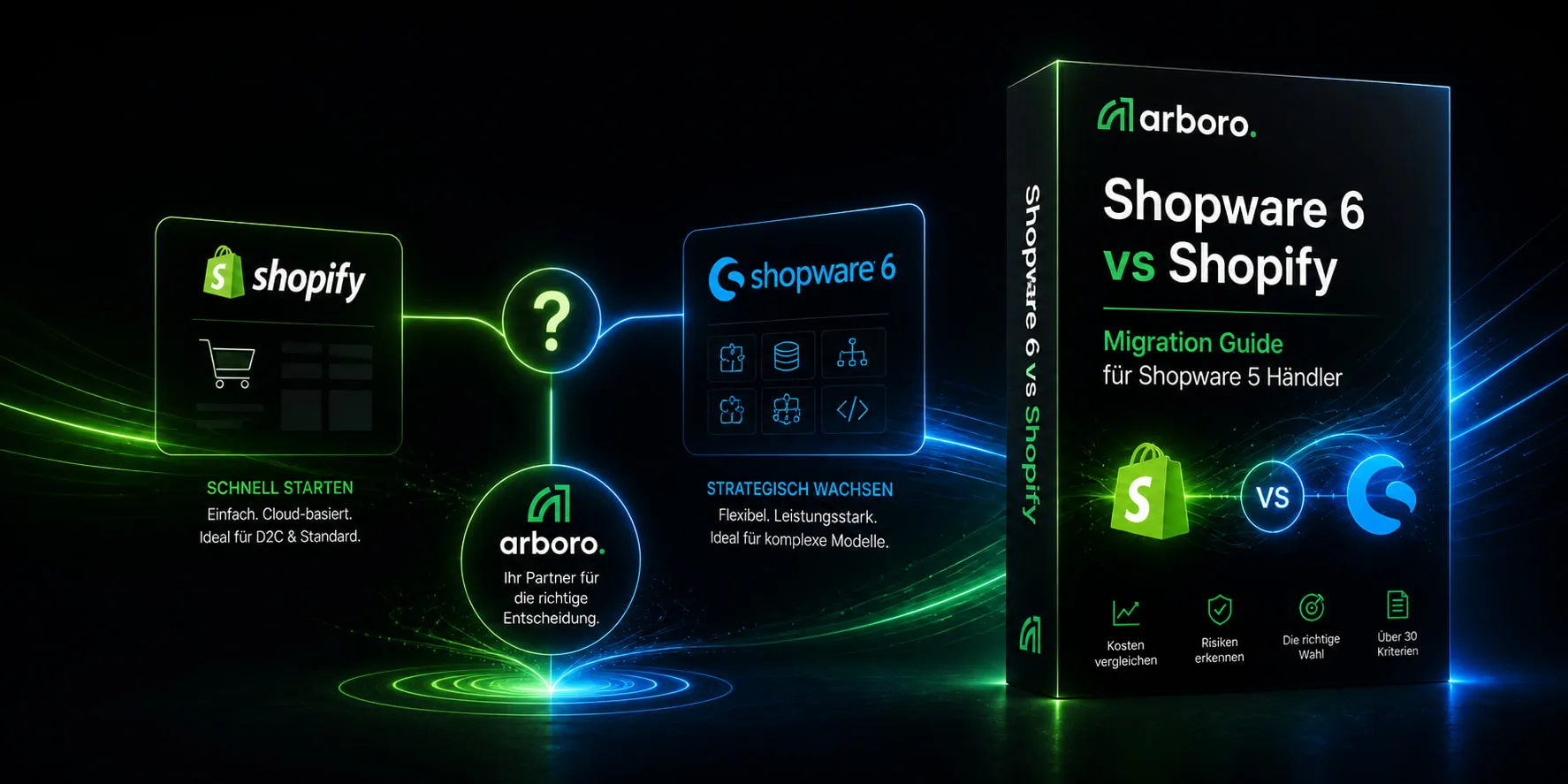
The detailed comparison as a practical report.
Not ready for a conversation yet? Then take the decision guide with you first, free of charge and with all the figures:
Migration costs for Shopware 6 and Shopify by project size
Operating costs in three revenue scenarios
The five most expensive migration mistakes
Decision matrix: which system fits which business model
And Shopware 5?
Shopware itself has not delivered regular updates for Shopware 5 since July 2024. Many established shops still run stably on it, often heavily customised. We continue to fully support Shopware 5, including custom plugin development. Security updates come from safefive, the long-term support provider for Shopware 5 after the official end of support.
You should migrate when it makes economic sense for your company, not because an agency needs a project. Whether Shopware 6 or Shopify is the right successor is shown in the practical report.
If you take responsibility for a shop later, you build it differently.
At many agencies, responsibility ends with go-live. For us, that is when the part that lasts longest for you begins: operation, updates, further development. We take responsibility for most of the shops we build after go-live too. Whether you want that is up to you. So we would end up paying for every shortcut in the code ourselves. Or you will.
Update-safe instead of core modifications
We implement custom features as separate extensions, not as interventions in the Shopware or Shopify standard. That keeps updates predictable.
As much standard as possible, as much custom development as necessary
For every requirement, we check whether the system standard, a proven extension or custom development is the most economical solution.
Staging and version control
Development never takes place in the live shop. Every change is versioned in Git and tested on a staging environment before it goes live.
Code review
Code only goes live after review by a second senior developer.
Documentation within the team
We document the architecture, integrations and special features of your shop centrally. Knowledge does not depend on one person, and you stay independent.
Performance from the start
We measure load time and Core Web Vitals during development, not only after complaints.
Clean code is in our own interest too: we usually remain responsible for it after go-live.
Your shop should not just work. It should move your business forward.
Clean technology is the foundation. It pays off where it brings revenue, saves work and gives you room for the next decision.
More buyers from the same visitors.
We design category pages, product pages and checkout based on user behaviour and sales psychology. Even small improvements have a big effect: if 3 instead of 2 out of 100 visitors buy, the number of orders rises by 50%. With the same basket value, revenue grows to the same extent, without spending a single euro more on advertising.
Processes that run without copy and paste.
Orders, stock levels, prices and customer data flow automatically between shop, ERP, PIM, CRM and logistics. Your team maintains data once and takes care of customers instead of spreadsheets.
New markets, channels and customer groups.
An extensible architecture supports further countries, languages, marketplaces or a B2B area without you having to rebuild the entire shop. You decide when you grow, not your technology.
Prepared for Google and AI search from the start.
A clean URL structure, structured data (JSON-LD) and well-maintained product data create the technical prerequisites for Google and AI systems such as ChatGPT or Gemini to understand your products.
Being found also takes convincing content and a strong brand. Working on that is our SEO and GEO team.
What we develop for you.
New shop & relaunch
From concept to go-live, on Shopware 6 or Shopify. Tailored to your range, processes and growth plans.
Migration
From Shopware 5 to Shopware 6, between Shopware and Shopify, or from systems such as Spryker, Magento, OXID, WooCommerce, Gambio or JTL to Shopware or Shopify. Switching from Spryker in particular often pays off: licence and development costs drop noticeably, and many features that have to be built individually there are already standard in Shopware 6 or Shopify. The transfer of relevant customer, order and product data and redirects for existing URLs are planned in advance. What can technically be transferred is clarified based on the source and target system.
Shopware plugins
Custom features right down to the business logic, built to be update-safe and documented.
Shopify custom apps & Functions
Custom apps, Shopify Functions for discount, shipping and payment logic, theme development and checkout extensions within your Shopify plan.
Integrations
ERP, inventory management, PIM, CRM, payment providers, shipping and marketplaces. With error handling and monitoring, so that stock levels do not stop unnoticed overnight.
B2B shops
Customer-specific prices, approval processes, quick ordering and requests for quotation.
Performance
Load times, caching, database and search, even for large ranges with many products and variants.
UX & conversion
User guidance and purchase process based on sales psychology, with a TÜV Rheinland-certified qualification at management level.
Tracking from go-live
GA4, Google Tag Manager, Consent Mode and, if required, server-side tracking as a TAGGRS Premium Partner.
Switching agencies
Your shop was built by another agency? Then we take it over in an orderly way and develop it further, usually without a rebuild.
A new shop must not put your visibility at risk.
Whatever rankings, regular customers and well-oiled processes your shop has today, you have built up over years. A relaunch should build on that, not drain it.
The riskiest moment is go-live. URLs, structures, templates and tracking change within a few hours. If something is lost, it often only shows weeks later in falling visibility and missing orders.
A typical case: the new shop is faster and nicer, but subcategories with rankings built up over years lead nowhere, and a payment method no longer reports purchases to Google Ads. The development, SEO and ads agencies each check their own part, and you become the go-between.
Our developers, SEO/GEO and SEA work in the same team. As an iBusiness Top 100 SEO service provider since 2013, we safeguard every relaunch in four steps:
Inventory
We record the URLs that bring rankings, visitors and revenue today, from Search Console, Analytics and our own crawler.
Redirects and structure
Every relevant old URL gets its target. We plan categories, filters, variants and structured data from the start.
Testing on staging
We test redirects, indexing rules, canonicals, tracking and product feed before the shop goes live.
Monitoring with arboro.PULSE
Our own diagnostic system checks availability every 5 to 15 minutes, regularly runs test purchases through to checkout and monitors tracking, feed and over 140 SEO criteria per page. If a deviation is confirmed in a second check, the responsible team is alerted by ticket, email, Teams or SMS depending on severity. Developers and SEO then fix the cause together.
A relaunch is only finished when visibility, tracking and orders have been checked. Not when the shop is online.
More on system-specific optimisation: Shopware SEO · Shopify SEO
The five most expensive mistakes in a migration.
From our shop projects and relaunch support over the last 17 years, we know the patterns that make migrations fail. In practice, they cost five- to six-figure sums and months of growth. And they can be avoided.
The platform is chosen before the requirements are clear.
The decision is based on gut feeling: “Shopify is easy”, “Shopware is German”. Only during the project does it become clear that the B2B structure, ERP depth or variants do not fit. The result is workarounds and, in the worst case, another migration after 12 to 24 months. Better: first a requirements catalogue, then the platform.
The old shop is copied one to one.
Category tree, URL logic and plugin dependencies move across unchanged, including all legacy issues. After 6 to 12 months, a second optimisation round follows, often in the range of €20,000 to €60,000. Better: use the migration as a fresh start and rethink structures beforehand.
SEO runs on the side.
Forgotten redirects, missing hreflang planning, broken structured data. A drop of 30 to 70% in organic traffic in the first months is then not unusual. Better: the SEO migration as a project of its own with preparation, go-live testing and monitoring.
The ERP “comes later”.
The shop goes live, the ERP integration follows at some point. Until then: manual data maintenance, wrong stock levels, wrong deliveries. And connecting it later costs more than planned. Better: the ERP integration belongs in the platform decision.
The decision is made for today, not for the next five years.
The platform fits today's shop size, but not the growth plan. After 12 to 24 months it hits its limits, and a second move becomes necessary. Total cost of a double migration including lost growth: €100,000 to €350,000.
The platform decision is a five-year decision. Not a five-week decision.
A sound analysis before the start costs a fraction of what a correction after go-live costs.
This is how your shop is created. With you at the wheel.
Initial consultation
Together we clarify goals, range, systems and timeframe. And whether a new shop is the right answer at all.
Analysis & system choice
In a free technical review, we look at your existing shop, integrations and processes and recommend Shopware or Shopify with reasons. The decision is yours.
Concept & offer
Scope of functions, integrations and schedule, as a fixed price or by effort.
Development in stages
On a staging environment that you can view at any time. We regularly agree interim results with you.
Testing before go-live
Features, checkout, integrations, redirects, tracking and feed.
Go-live
At a low-traffic time, with a prepared go-live plan, data backup and a defined fallback procedure. Your shop is then immediately connected to arboro.PULSE.
Operation & further development
Via shop support with the right SLA.
You see your shop grow before it goes live. And you know where your project stands at every step.
What shop development at arboro costs.
A reliable price only emerges once requirements, integrations and data volumes are clear. That is why every offer is preceded by an analysis. Getting started is free: a technical review of 1 to 2 hours in which we look at your shop, your extensions and your integrations.
| Fixed price | By effort | |
|---|---|---|
| Best for | Projects with a clearly defined scope | Projects that evolve step by step, and ongoing development |
| Basis | Concept with a defined scope of functions | €150 per hour excl. VAT, billed by the minute |
| Your advantage | Predictable budget | You only pay for what is needed |
| Transparency | Changes to scope with a cost estimate in advance | Activity record per task and team member |
Fixed price
- Best for
- Projects with a clearly defined scope
- Basis
- Concept with a defined scope of functions
- Your advantage
- Predictable budget
- Transparency
- Changes to scope with a cost estimate in advance
By effort
- Best for
- Projects that evolve step by step, and ongoing development
- Basis
- €150 per hour excl. VAT, billed by the minute
- Your advantage
- You only pay for what is needed
- Transparency
- Activity record per task and team member
All disciplines are billed at the same hourly rate, with no surcharges for project management or architecture. So you always know what an hour costs and what it was used for.
After go-live
Operation runs via our shop support. SLA-1 costs €99 per month excl. VAT and includes staging, shop, server and feed monitoring as well as the software licences for monitoring. Updates and further development are billed by effort; from SLA-2, monthly plugin updates are included.
Have existing offers reviewed
Already have offers from other agencies? Send them to z.artmagic@arboro.de. They are reviewed free of charge and in confidence for how custom requirements are implemented and where follow-up costs are hidden.
Check funding
Many digitalisation projects in SMEs are eligible for funding. Whether your project qualifies is checked before the start by Zoran Artmagic, a certified advisor for public funding.
Five questions about your shop. How many can you answer right away?
0 of 5 answered
Which version is your shop running on, and when was the last major update?
How many plugins or apps are installed, and what is each one needed for?
Who knows your ERP integration well enough to fix it if something goes wrong?
Which of your current URLs bring revenue, and what happens to them in the next relaunch?
Do you have access to your theme, your custom extensions and the technical documentation of your shop?
Shops from people who take responsibility beyond go-live.
Shopware since 2009, Shopify since 2019
Shopware Gold Partner from the very beginning, over 160 Shopware projects, Shopify Partner since 2019.
Certified quality
ISO 9001-certified quality management by TÜV SÜD, Google Premier Partner, iBusiness Top 100 SEO since 2013.
Professionally insured
arboro has IT liability and cyber insurance. Professional provision has been made for the worst case too.
Long-term partnerships
More than 50% of our clients have worked with us for over eight years, some for more than 15 years.
Who builds your shop
Good shops are created by people who understand your business, not just your code.
Senior specialists for development, project management and support
Your shop is in the hands of a permanent team of experienced developers and project managers. Knowledge and responsibility are shared and documented within the team. That way, your project is always in good hands.
Closely linked with SEO, GEO and SEA
The development team aligns decisions in the code directly with colleagues from SEO/GEO and SEA. Redirects, structured data and tracking are part of development from the start.
Responsibility beyond go-live
If you wish, the same team takes responsibility for your shop in operation and further development: updates, monitoring with arboro.PULSE and new features. Whether and to what extent is up to you.

Florian Gronau
Head of Development / Authorised Signatory

Christopher Wagner
Senior Software Engineer / Technical Lead
Dirk Persky
Head of Shop Support

Alexandra Kuhn-Spannbauer
Senior E-Commerce Project Manager

Susi Streitberger
Senior Frontend Developer

Dominic Schmassmann
Senior Full-Stack Developer

Patrizia Hammann
Senior Full-Stack Developer

Karl-Heinz Harris
Senior Backend Developer

Shopware and Shopify. Both in our DNA.
Managing Director Zoran Artmagic has worked with Shopware since version 2 and has been active in shop development and shop support since 2009. In 2019, Shopify followed as an official partner. Since then, arboro has developed on both systems, with the same depth right down to the code.
That is arboro's DNA: Your shop gets the system that fits your business model. Not the one an agency would most like to sell. Zoran Artmagic also combines technology with TÜV Rheinland-certified sales psychology and a UX qualification (UXQB® CPUX-F). And he thinks like an entrepreneur: a shop has to pay off, not just look good.
The difference for your shop:
arboro builds Shopware and Shopify shops, takes responsibility for them after go-live if you wish, makes them visible with SEO/GEO and SEA, brings your products to marketplaces and portals, and aligns every decision with your revenue.

Shops we develop and take responsibility for.

rct-online.de
Rct-online.de
Numerous innovations for Reichelt Chemietechnik B2B: arboro combines analysis, SEO strategy and the RCT magazine as a strong specialist medium and SEO factor.
drogerieshop24.ch
Drogerieshop24.ch
How Drogerieshop24, together with arboro, reorganized the category structure, positioned the Abderhalden own brand more clearly and significantly increased visibility
meinhausshop.de
MeinHausShop.de
How MeinHausShop has been continuously growing together with arboro for years – through Shopware optimization, sustainable SEO strategies, SEA and technical further development.
rekubik.de
REKUBIK.de
How REKUBIK, with Shopware updates, custom development, SEO and SEA, is increasing its visibility together with arboro and offering customers a significantly improved shopping experience.
Who we are a fit for.
For manufacturers and retailers whose online shop is a business-critical sales channel, in B2C, B2B or D2C. For managing directors and shop managers who want a shop that will still be economical to run in five years, and who prefer to make decisions with complete figures.
Who we are not a fit for.
If your shop is to stay on a system other than Shopware or Shopify. If only the lowest project price counts. And if you are looking for an agency that disappears after go-live.
Frequently asked questions about shop development.
Because depth is worth more than breadth. arboro has worked with Shopware since version 2 and as a Gold Partner since 2009, with Shopify as an official partner since 2019. Because we offer both systems, we recommend neutrally what fits your business model. From other systems, we migrate to Shopware or Shopify.
Shopware 6 is strong in complex B2B processes, custom pricing logic and deep ERP integration. Shopify fits when a fast start, lean infrastructure and international selling are the priority. We justify our recommendation; the decision is yours. More in the practical report Shopware 6 or Shopify.
The price really is individual. It depends above all on what is connected and built specifically: ERP and inventory management, marketplaces, B2B logic, design and data volumes. As a rough guide for new shops and migrations (net, DACH market prices 2026):
Shopware 6: small €15,000 to €40,000, medium €40,000 to €80,000, large €80,000 to over €200,000
Shopify: small €10,000 to €30,000, medium €30,000 to €65,000, large €65,000 to over €150,000
Small means standard theme and few integrations, medium means custom design with ERP and marketplace, large means custom development, B2B and multi-channel. After the analysis, you receive an offer as a fixed price or by effort, at the uniform hourly rate of €150 excl. VAT. What matters more than the project price is the total cost over the lifetime. How big the difference can be is shown by the follow-up cost calculator.
Yes, free of charge and in confidence. Send the offers to z.artmagic@arboro.de. We look at how custom requirements are to be implemented, which extensions and integrations are planned and where follow-up costs may arise. You get an honest assessment, even if the offer is good. How strongly the build approach affects follow-up costs is shown by the follow-up cost calculator.
Every relaunch is a risk to visibility. That is why our SEO/GEO team is involved from the concept stage: an inventory of the URLs that bring rankings and revenue today, redirects for every relevant old URL, testing on staging and monitoring after go-live. That way, risks are identified beforehand and not afterwards.
No. Shopware has not delivered regular updates for Shopware 5 since July 2024. We nevertheless continue to fully support Shopware 5, including custom plugin development. Security updates come from the long-term support provider safefive. We will work out together when a migration makes economic sense.
Often, yes. Spryker causes high licence and development costs, and many features have to be built individually there that Shopware 6 or Shopify already include as standard. Which target system fits and what can be transferred is clarified in the analysis before the project. We plan your data, URLs and integrations from the outset.
Yes. First we review code, extensions, integrations, hosting and tracking. You get an honest status report, and the shop is taken over step by step. Often no rebuild is needed. Details on our shop support.
Your shop is connected to arboro.PULSE. If you wish, we take responsibility for operation and updates via shop support, from SLA-1 for €99 per month excl. VAT. You can add SEO & GEO, Google Ads or server-side tracking at any time, with no package obligation.
We create the technical prerequisites: clean product data, structured data in JSON-LD, fast load times and open interfaces. Whether your products are recommended in AI answers also depends on content and brand authority. Where your existing shop stands is shown by the AI readiness check.
Which shop will fit your company in five years?
Whether a new shop, relaunch, migration or further development: together we look at your starting point, your systems and your goals. Afterwards, you know which system fits, what it realistically costs and whether a new shop is the right step at all. So that you invest correctly today and your shop does not become an expensive renovation project tomorrow.
No standard presentation, but a well-founded assessment for your shop. From people who build shops and take responsibility for them, and who will also tell you when a step is not worth it for you. You then make the decision in your own time.