Shopware Gold Partner & Shopify Partner
Shopware 5 migration: to Shopware 6 or Shopify.
A migration is a project of a few months. The platform you choose will carry you for the next five years.
Your Shopware 5 store is running, earning money and has built up rankings, loyal customers and well-oiled processes over the years. A migration should build on that, not eat into it.
arboro is a partner for both target systems and has migrated stores in both directions. So you get a reasoned recommendation instead of a preference.
Shopware & Shopify development · Support · Agency switch · Shop migration · SEO/GEO · SEA · AI commerce





Shopware 5 has reached its end. Your store is far from it.
Since 31 July 2024, Shopware has no longer provided updates, security patches or bug fixes for Shopware 5.
Many pages on this topic turn that into a threat scenario. We think that is the wrong approach. A well-maintained Shopware 5 store does not become insecure overnight. But it does become more expensive to run every year: extensions no longer get updates, payment providers and marketplaces change their interfaces, new PHP versions turn into construction sites, and good Shopware 5 developers become scarcer.
So the real question is not whether you migrate. It is: when it makes economic sense for your company, where to, and how to lose nothing of what your store earns today.
Three paths. All three are legitimate.
Stay on Shopware 5, for now
With paid long-term support from safefive, an independent provider of security updates after the official end of support, and an agency that still masters Shopware 5. Makes sense if the store runs stably, other projects take priority or the platform decision is not yet ripe. Not a permanent state, but a clean bridge. A fit if: you need time for a good decision.
Migration to Shopware 6
Same manufacturer, but a completely new system with a different architecture, a different template system and different extensions. Strong for highly individual business logic, complex pricing and approval processes, deep ERP integration, several stores from one data set and full control over technology, URL and category structure. A fit if: your business model needs freedom within the system.
Switch to Shopify
SaaS platform from Canada; hosting, security and updates are handled by Shopify. Strong for a fast start, lean operation, international selling and Shop Pay in mobile checkout. Basic B2B functions are now also available below Shopify Plus. Limits show with more than three option types per product and deep changes to the business logic. A fit if: you want to run your processes lean and without your own infrastructure.
We continue to fully support Shopware 5, including custom plugin development. So we have no reason to push you into a migration. You should migrate when it makes economic sense for your company, not because an agency needs a project.
How much time do you really have?
Whether you should migrate in three months or in two years is not decided by the calendar, but by the condition of your store.
0 of 6 answered
Does your store still receive security updates today, for example via long-term support for Shopware 5?
Are all your plugins still maintained by their vendors and running without workarounds?
Do your payment providers, marketplaces and inventory management still support Shopware 5 without restrictions?
Can new requirements still be implemented in your store without hearing “that’s no longer possible in Shopware 5”?
Will your business model stay as it is for the next two years, i.e. no new B2B area, new countries, marketplace or second store?
Are your store’s visibility, loading time and conversion rate stable or rising?
Unsure about one of the questions? That is exactly what we clarify in the free technical review, even if the result is: there is no rush.
Shopware 6 or Shopify: the answer lies in your business model.
In practice, the platform is often chosen by gut feeling. “Shopify is easy.” “Shopware is German.” Both are true, and both are almost meaningless for your decision.
What matters is what your business will need in five years. If you sell plain D2C today and want to serve business customers with their own pricing rules and approval chains in two years, you have to factor that in today. If you run twelve plugins for special logic today that you no longer really need, you may end up paying for freedom with Shopware 6 that you don’t use.
Because we develop on both systems, we earn on both. We recommend what fits your business model, even if the other system would be the bigger project for us. That is why we have also turned down enquiries where the desired system did not fit the business model. Better no project than one that fails in twelve months.
Shopware 6 or Shopify? Your decision briefing
16 questions, plus two follow-ups depending on your answers, under four minutes. At the end you receive a briefing with recommendation, reasons, risks, project complexity, migration risk, cost guide values and the points to clarify before deciding. Nothing is stored unless you send it.
Step 1 of 6
Business model
How you sell
The two systems in an honest comparison.
| Shopware 6 | Shopify | |
|---|---|---|
| Operation | Own hosting or Shopware Cloud, server location in Germany available | Hosting, security and updates handled by Shopify |
| Strong in | Individual business logic, complex pricing and approval processes, deep ERP integration, several stores from one data set | Fast start, lean operation, international selling, POS system, Shop Pay |
| B2B | Customer groups, rules and B2B functions customisable down to special logic | Company accounts, catalogues and payment terms also below Plus; more configuration with Shopify Plus; special logic via apps or custom development |
| Customisability | Down to the business logic, custom plugins, freely designable checkout | Custom apps, Shopify Functions and theme development; checkout customisation via apps and Functions, deep changes to information, shipping and payment pages mainly with Shopify Plus |
| Products | Flexible properties and variants without Shopify’s three-option limit | Up to 2,048 variants, but no more than three option types per product |
| SEO | Free URL and category structure, noindex and structured data directly controllable | Fixed paths such as /products/ and /collections/, flatter category structure, some things only via theme code or app |
| Running costs | Hosting, maintenance, a paid edition depending on GMV | Shopify plan, app fees, transaction fees depending on payment method |
| Limits | More responsibility for hosting, updates and security | Core logic only via designated interfaces, API limits with large data volumes |
Shopware 6
- Operation
- Own hosting or Shopware Cloud, server location in Germany available
- Strong in
- Individual business logic, complex pricing and approval processes, deep ERP integration, several stores from one data set
- B2B
- Customer groups, rules and B2B functions customisable down to special logic
- Customisability
- Down to the business logic, custom plugins, freely designable checkout
- Products
- Flexible properties and variants without Shopify’s three-option limit
- SEO
- Free URL and category structure, noindex and structured data directly controllable
- Running costs
- Hosting, maintenance, a paid edition depending on GMV
- Limits
- More responsibility for hosting, updates and security
Shopify
- Operation
- Hosting, security and updates handled by Shopify
- Strong in
- Fast start, lean operation, international selling, POS system, Shop Pay
- B2B
- Company accounts, catalogues and payment terms also below Plus; more configuration with Shopify Plus; special logic via apps or custom development
- Customisability
- Custom apps, Shopify Functions and theme development; checkout customisation via apps and Functions, deep changes to information, shipping and payment pages mainly with Shopify Plus
- Products
- Up to 2,048 variants, but no more than three option types per product
- SEO
- Fixed paths such as /products/ and /collections/, flatter category structure, some things only via theme code or app
- Running costs
- Shopify plan, app fees, transaction fees depending on payment method
- Limits
- Core logic only via designated interfaces, API limits with large data volumes
Note on licensing: The free Community Edition of Shopware 6 is subject to a Fair Usage Policy. If your Shopware online store generates more than €1 million GMV within 365 days and you use the Shopware Account or Extension Store, you need a paid plan. Rise currently starts at €600 per month. Since 14 April 2026, GMV reporting has been automated from Shopware 6.7.8. For many Shopware 5 merchants with revenue in the millions, this licence therefore belongs in the calculation from the start.
Two Shopware 5 stores. Two different decisions.
Almost all Shopware 6 stores that arboro is responsible for today used to be Shopware 5 stores. Some merchants went to Shopify instead. Both were right, because the decision came from the business model.
Horsch-Shop: from Shopware 5 to Shopify.
Starting point: The family business Horsch sells shoes in oversizes and undersizes. arboro had previously developed the store on Shopware 4 and then on Shopware 5.
Decision: Shopify. The switch was planned from the start with SEO in mind, so that the visibility built up over years would move to the new platform.
“arboro built our store on Shopware 4, then Shopware 5, and then accompanied us in switching to Shopify. That our customers still find us on Google and in AI search after the move was crucial for us as a family business.”
Felix Horsch, Horsch-Schuhe
More: Shopify SEO
Drogerieshop24.ch: from Shopware 5 to Shopware 6.
Starting point: Behind Drogerieshop24.ch stands Abderhalden Drogerie AG from Toggenburg, a Swiss family business since 1945 with its own brand and around 70 other brands in its range. The categories were deeply nested, and several competed for the same search terms.
Decision: Shopware 6. In mid-2026, arboro moved the store and used the switch for a flatter category structure, a new UX design and a newly set up content strategy. The trickiest part was invisible: every page under a new URL needed a redirect before go-live, otherwise the store would have lost the rankings it had built up over two years.
What comes along. And what doesn’t.
“Your data will be transferred in full” is written in almost every migration offer. For products, customers and orders, that is usually true. What gets expensive are the things nobody listed.
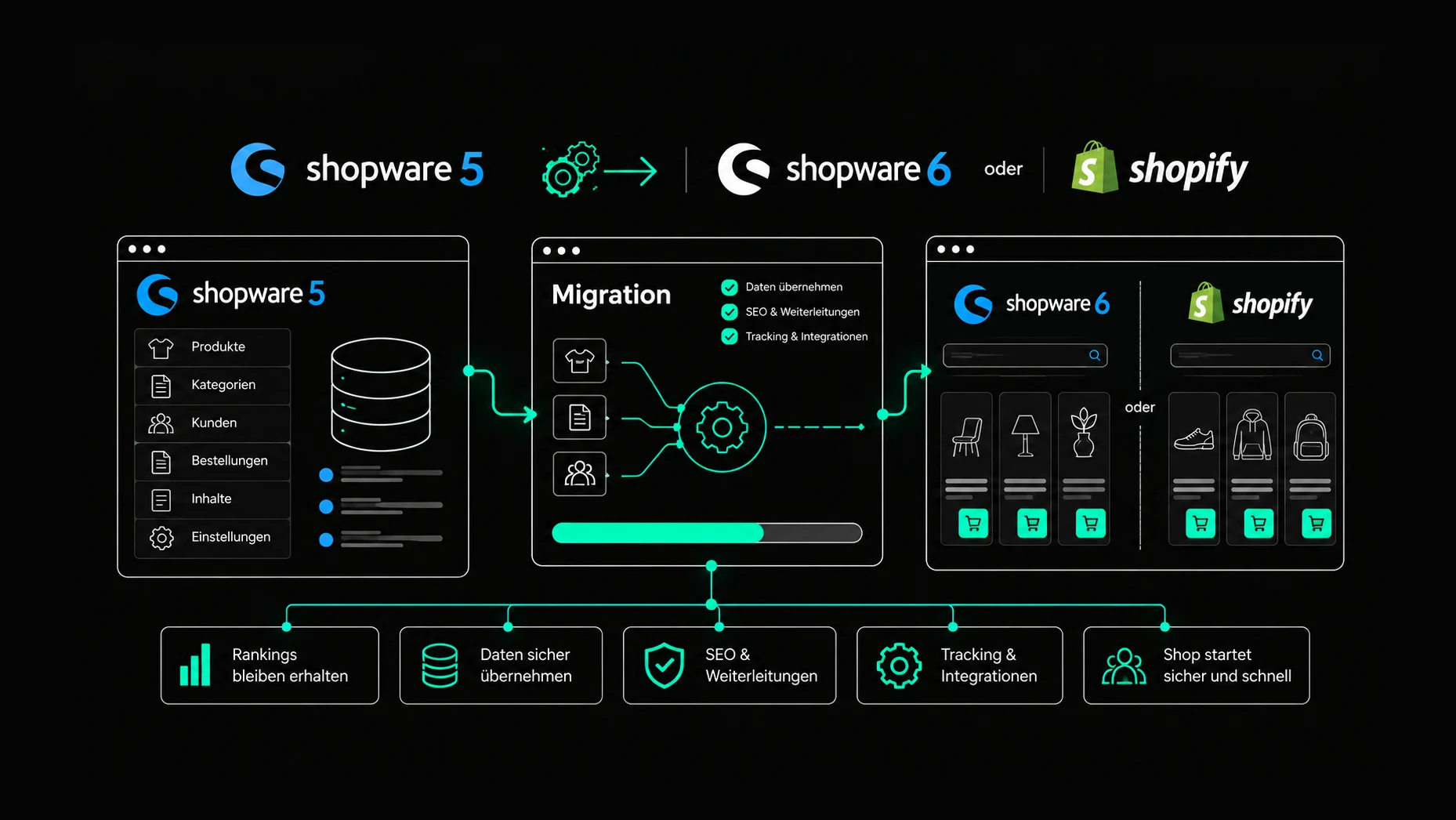
For the route to Shopware 6, Shopware provides an official migration assistant. It transfers the master data, checks beforehand for missing or unassignable records and can later sync only changed data. For Shopify there are import tools and migration services; for larger data volumes we work with our own scripts via the Shopify API. None of them answers the question of which special cases your store has collected over the years.
| Data area | Shopware 5 → Shopware 6 | Shopware 5 → Shopify |
|---|---|---|
| Products, manufacturers, images | includedTransferred (migration assistant) | includedTransferred (import or script) |
| Variants | includedTransferred | Restructured if a product has more than three option types |
| Categories | includedTransferred, hierarchy is kept | Restructured: categories become collections, the structure becomes flatter |
| Customers and addresses | includedTransferred | includedTransferred |
| Customer passwords | includedUsually remain valid, Shopware 6 recognises the old passwords | Cannot be transferred, customers set a new password |
| Order history | includedTransferred | includedTransferred, as historical orders |
| Customer groups and customer prices | With mapping to customer groups and rules | With mapping to company accounts and catalogues; check scope depending on Shopify plan and pricing logic |
| Free text fields | With mapping to custom fields | With mapping to metafields |
| Reviews | includedTransferred | Via import into a reviews app |
| Newsletter subscribers | includedTransferred, secure proof of consent | includedTransferred, secure proof of consent |
| Shopping worlds | Rebuilt as Shopping Experiences | Rebuilt in the theme |
| Design and template | Rebuilt (Twig instead of Smarty) | Rebuilt (Liquid) |
| Plugins and special logic | Reassessed: standard, new plugin or custom development | Reassessed: standard, app or custom app |
| URLs and SEO | SEO URLs can be transferred; SEO settings, URL structure and redirects must then be checked and partly reconfigured | Fixed Shopify paths change many URLs; 301 redirects must be planned |
| Tracking and feeds | Set up again and tested | Set up again and tested |
Shopware 5 → Shopware 6
- Products, manufacturers, images
- includedTransferred (migration assistant)
- Variants
- includedTransferred
- Categories
- includedTransferred, hierarchy is kept
- Customers and addresses
- includedTransferred
- Customer passwords
- includedUsually remain valid, Shopware 6 recognises the old passwords
- Order history
- includedTransferred
- Customer groups and customer prices
- With mapping to customer groups and rules
- Free text fields
- With mapping to custom fields
- Reviews
- includedTransferred
- Newsletter subscribers
- includedTransferred, secure proof of consent
- Shopping worlds
- Rebuilt as Shopping Experiences
- Design and template
- Rebuilt (Twig instead of Smarty)
- Plugins and special logic
- Reassessed: standard, new plugin or custom development
- URLs and SEO
- SEO URLs can be transferred; SEO settings, URL structure and redirects must then be checked and partly reconfigured
- Tracking and feeds
- Set up again and tested
Shopware 5 → Shopify
- Products, manufacturers, images
- includedTransferred (import or script)
- Variants
- Restructured if a product has more than three option types
- Categories
- Restructured: categories become collections, the structure becomes flatter
- Customers and addresses
- includedTransferred
- Customer passwords
- Cannot be transferred, customers set a new password
- Order history
- includedTransferred, as historical orders
- Customer groups and customer prices
- With mapping to company accounts and catalogues; check scope depending on Shopify plan and pricing logic
- Free text fields
- With mapping to metafields
- Reviews
- Via import into a reviews app
- Newsletter subscribers
- includedTransferred, secure proof of consent
- Shopping worlds
- Rebuilt in the theme
- Design and template
- Rebuilt (Liquid)
- Plugins and special logic
- Reassessed: standard, app or custom app
- URLs and SEO
- Fixed Shopify paths change many URLs; 301 redirects must be planned
- Tracking and feeds
- Set up again and tested
✓ = transferred · no tick = with mapping, checking or rework, or rebuilt
The table shows the typical case. What exactly can be transferred in your store depends on plugins, data quality and your Shopware 5 version. That is why every project starts with an inventory: which plugins are installed, which are still needed, which free text fields are actually used, which data is legacy?
In Shopware 5 stores that have grown over time, we regularly find plugins that are no longer needed in Shopware 6 or Shopify because the function is now standard. Every plugin that disappears no longer causes rework with future updates. On the route to Shopware 6, purchased plugin licences can partly be transferred, provided the vendor offers a Shopware 6 version.
The Monday after go-live.
Imagine one of your regular customers. She has been ordering from you every few months for six years, always via the bookmark in her browser.
On the Monday after go-live, she clicks on it as usual. If her old URL was not redirected, she lands on an error page. She searches for your store on Google. The old category page is still listed there, and it leads nowhere either. If she does make it to the home page, she wants to log in. If the store was migrated to Shopify and nobody prepared the new password process, she can’t get into her account. She can’t see her order history, which she normally uses to reorder quickly.
None of these steps is a drama. Together, they are the moment when a loyal customer thinks: “Then I’ll just order somewhere else.” She doesn’t get in touch with you. She simply goes missing from the statistics.
That is why we plan a migration not from the system’s point of view but from the customer’s: what do a regular customer, a Google visitor, a business customer and your warehouse experience on the first day after the move?
Your rankings don’t move by themselves.
There is a sentence in the Shopware forum that describes the situation well: for stores that make most of their revenue via Google, a migration without real SEO expertise is dangerous. We agree.
In a migration, URL structure, templates, internal linking and structured data can change profoundly. When switching to Shopify, the predefined paths change a particularly large number of URLs. With Shopware 6, existing SEO URLs can be transferred, but individual SEO settings must be reconfigured, and the new template and the new internal linking still change how Google reads your store. A poorly prepared migration can cost a considerable share of organic traffic, and with it revenue that you then have to make up for expensively with advertising budget.
The danger is rarely the big problem that becomes obvious on go-live day. The danger lies in the subcategories that ranked for years and now quietly lead to an error page, or in the payment method that no longer reports purchases to Google Ads, so that your campaigns optimise on wrong data.
At arboro, developers, SEO/GEO and SEA work in the same team. As one of the Top 100 SEO service providers in the German-speaking region since 2013, we safeguard every migration in four steps:
Inventory by revenue, not by volume
We capture all URLs that bring rankings, visitors and revenue today, from Search Console, Analytics and our own crawler. Your most important pages get their own review instead of just sitting in a list of ten thousand rows.
Redirects and structure
Transferred SEO URLs and SEO settings are checked and reconfigured where necessary; every changed relevant URL gets a matching target, not simply the home page. Categories, filter pages, variants, hreflang and structured data are planned in from the start. Legacy issues in the URL structure are cleaned up rather than copied.
Testing on staging
Redirects, indexing rules, canonicals, tracking, consent, product feed and access for AI crawlers are tested before the store goes live.
Monitoring with arboro.PULSE
From go-live, your store is connected to our own diagnostic system. It checks availability every 5 to 15 minutes, runs test purchases through to checkout and monitors tracking, feed and more than 140 SEO criteria per page. If something deviates, the alert goes to the person who can fix the cause.
A migration is only finished once visibility, tracking and orders have been checked. Not when the new store is online.
More on system-specific optimisation: Shopware SEO · Shopify SEO · GEO for online stores · arboro.PULSE
This is how your migration runs. With you at the wheel.
For your team, a migration is a state of emergency, in practice usually two to six months. The clearer the process, the less of it reaches day-to-day business.
Initial call
Goals, product range, systems, timeframe. And the honest question of whether now is the right time.
Free technical review
In one to two hours, we look at your Shopware 5 store: version, plugins, template customisations, free text fields, integrations, data quality, SEO starting point. Afterwards you know the real cost drivers of your project.
Requirements and recommendation
Requirements first, then the platform. You receive a recommendation for Shopware 6 or Shopify, including the points that speak against it. You make the decision.
Concept and offer
Scope of functions, plugin and app decisions, integrations, redirect concept and schedule. As a fixed price or by effort.
Build on staging with test migrations
The new store is built on a staging environment that you can see at any time. We run several trial migrations, check the data and correct errors at the source before they end up in the new system.
Go-live with delta migration
On go-live day, only the data that has changed since the last test migration is transferred: new orders, new customers, changed stock levels. This keeps the period in which the store is frozen as short as possible. The switch happens at a low-traffic time, with a data backup and a defined fallback plan.
Safeguarding after go-live
Redirects, indexing, tracking, feed and orders are closely monitored in the first weeks, with arboro.PULSE from day one.
Operation and growth
If you wish, the same team takes responsibility for your store afterwards too, via shop support with the right SLA.
Your Shopware 5 store keeps running until the new one is safely in place.
If you wish, we take responsibility for it in the meantime, so that no gap opens up between the old and the new agency.
What a Shopware 5 migration costs.
Migration costs hardly ever depend on the number of products. A store with 50,000 simple items is often easier to migrate than one with 500 items and complex B2B logic. Costs arise from custom design, special logic in plugins, integration with inventory management and marketplaces, and the number of integrations.
Guide values.
| Project size | Shopware 6 | Shopify |
|---|---|---|
| Small: standard theme, basic configuration, few integrations | €15,000 to €40,000 | €10,000 to €30,000 |
| Medium: custom design, ERP, marketplace, more complex processes | €40,000 to €80,000 | €30,000 to €65,000 |
| Large: custom development, several integrations, B2B, multichannel | €80,000 to over €200,000 | €65,000 to over €150,000 |
Shopware 6
- Small: standard theme, basic configuration, few integrations
- €15,000 to €40,000
- Medium: custom design, ERP, marketplace, more complex processes
- €40,000 to €80,000
- Large: custom development, several integrations, B2B, multichannel
- €80,000 to over €200,000
Shopify
- Small: standard theme, basic configuration, few integrations
- €10,000 to €30,000
- Medium: custom design, ERP, marketplace, more complex processes
- €30,000 to €65,000
- Large: custom development, several integrations, B2B, multichannel
- €65,000 to over €150,000
Guide values, net, DACH market prices 2026
Shopify is usually cheaper to migrate to. Whether it stays that way in operation depends on the Shopify plan, app costs, transaction fees and the effort for technical SEO. The calculation over five years is what counts, not the project price. Our follow-up cost calculator shows how big the difference can become.
Always included.
Setting up the new platform
Data migration: products, categories, customers, order history
Theme, standard or custom
Replacing the most important plugins with standard functions, extensions or apps
Payment, shipping and taxes
Redirect concept, testing and go-live
Often added.
Integration with ERP and inventory management
Marketplaces such as Amazon, eBay or Otto
Custom UX and design concept
Custom plugins or custom apps
B2B processes and customer-specific logic
Several stores and internationalisation
Training for your team
How we bill.
| Fixed price | By effort | |
|---|---|---|
| Best for | Migrations with a clearly defined scope | Projects that evolve step by step |
| Basis | Concept with a defined scope of functions | €150 per hour excl. VAT, billed by the minute |
| Your advantage | Predictable budget | You only pay for what is needed |
| Transparency | Changes to scope with a cost estimate in advance | Activity record per task and team member |
Fixed price
- Best for
- Migrations with a clearly defined scope
- Basis
- Concept with a defined scope of functions
- Your advantage
- Predictable budget
- Transparency
- Changes to scope with a cost estimate in advance
By effort
- Best for
- Projects that evolve step by step
- Basis
- €150 per hour excl. VAT, billed by the minute
- Your advantage
- You only pay for what is needed
- Transparency
- Activity record per task and team member
The same hourly rate applies to all disciplines, with no surcharges for project management or architecture, including SEO and tracking during the migration.
Why a flat price without analysis is a warning sign
Anyone who quotes you a fixed price without looking at plugins, free text fields and integrations has either built in a generous buffer or miscalculated. In the second case, the collaboration becomes unpleasant: every requirement suddenly costs extra, deadlines slip. In the end you pay twice, once in money and once in nerves.
Have existing offers reviewed
Do you already have migration offers? Send them to z.artmagic@arboro.de. You will find out free of charge and in confidence what is missing, where follow-up costs are hidden and whether the price is realistic. If the offer is good, we will tell you that too.
Check funding
Many digitalisation projects at SMEs in Germany are eligible for public funding. Whether this applies to your migration is checked by Zoran Artmagic, a certified public funding consultant, before the project starts. Important: as a rule, only what was applied for before the order is placed gets funded.
Offers for a free review: z.artmagic@arboro.de · Whether your migration qualifies for public funding in Germany: funding consulting
The most expensive mistakes look sensible at the start.
No merchant deliberately chooses a bad migration. The expensive mistakes arise from decisions that seem sensible at the time: saving time, protecting the budget, just going live first. We know these patterns from our own projects and from relaunches we have supported for other agencies. Some of them we used to do differently ourselves than we would today.
What it leads to: Category tree, URL logic and plugin dependencies move across together with all their legacy issues. A few months after go-live, a second round of optimisation is due that could have been avoided.
What we do instead: Migrate the data, rethink the structures. Data migration and structural migration are two different things.
What it leads to: During the project it turns out that pricing logic, variants or ERP depth don’t fit the platform. Workarounds follow and, in the worst case, a second migration that ties up budget, time and your team’s energy a second time.
What we do instead: First a requirements catalogue with a view to the next five years, then the platform.
What it leads to: Forgotten redirects, broken hreflang, lost structured data. Followed by months in which you make up for lost organic traffic with advertising budget.
What we do instead: SEO is part of the project from the concept stage, with its own responsibility and test protocol.
What it leads to: Months of manual data maintenance, wrong stock levels, wrong deliveries. The later integration becomes more expensive than planned.
What we do instead: The ERP integration belongs in the platform decision. With Shopify, we calculate the API limits using your real data volumes.
What it leads to: Special logic ends up directly in the theme instead of in update-safe extensions. Every later update becomes a project.
What we do instead: We build custom functions as separate extensions so that the new store remains predictable even after the fifth update.
The platform decision is a five-year decision, not a five-week decision.
A sound analysis before the start costs a fraction of what a correction after go-live costs.
Until then: run Shopware 5 safely.
A good migration needs lead time. During this period, your Shopware 5 store has to run safely and generate revenue.
The security updates come from safefive; plugin adjustments and further development are handled by our team. arboro.PULSE also monitors Shopware 5 stores and detects silent errors such as failing payment methods, rejected products in the feed or broken tracking before they cost revenue.
Your advantage: whoever takes responsibility for your Shopware 5 store day to day knows its special cases. That knowledge later flows into the migration instead of getting lost in a handover.
Not ready for a conversation yet?
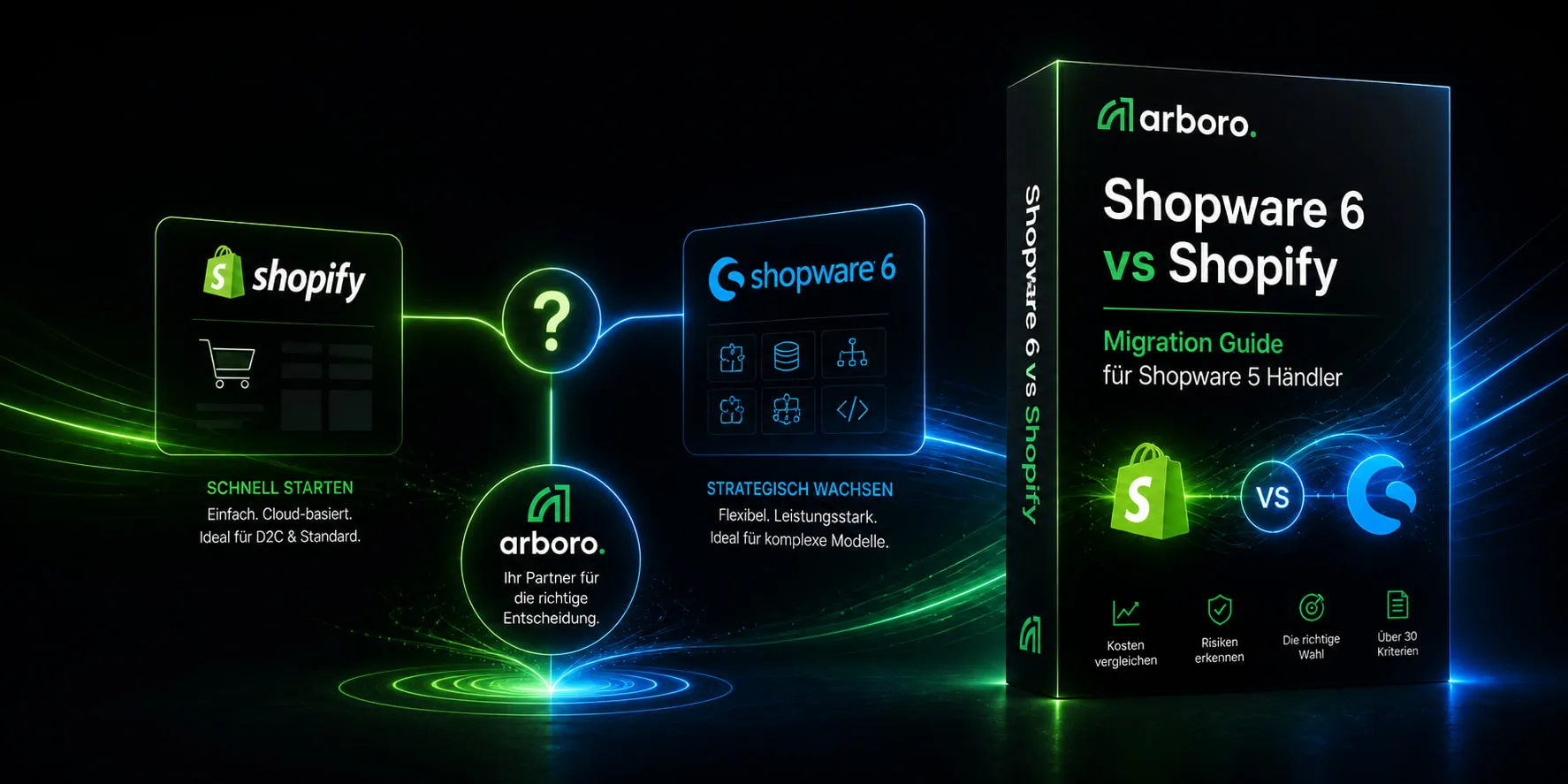
Then take the decision guide with you first, free of charge and with all the figures. The practical report “Shopware 5: Shopware 6 or Shopify?” has 41 pages (in German):
Migration costs for Shopware 6 and Shopify by project size
Licence, hosting and app costs of both systems
Operating costs in three revenue scenarios
Additional SEO, SEA and GEO effort as a hidden cost factor
Direct comparison across 35 criteria
The five most expensive mistakes in Shopware 5 migrations
Decision matrix: which system fits which business model
Migration by people who know both sides.
Partner for Shopware and Shopify
Shopware Gold Partner since 2009, working with Shopware since version 2. Shopify Partner since 2019. We have migrated from Shopware to Shopify, from Shopify to Shopware and from systems such as Magento or OXID to both platforms.
Development, SEO, SEA and tracking at the same table
In a migration, code, rankings, campaigns and measurement interlock. You don’t have to coordinate three service providers who each only check their own part.
Responsibility that doesn’t end at go-live
We take responsibility for most of the stores we migrate afterwards too. So we would pay for every shortcut in the migration ourselves later on.
Insured and audited
ISO 9001 certified quality management, IT liability and cyber insurance, development only on staging with version control and code review.
Your store belongs to you
You receive the rights of use to everything we develop for your store. Hosting and licences are in your name. You can get the complete repository and documentation at any time.

A word from Zoran Artmagic.
“I have been working with Shopware since version 2 and in 17 years I have seen many migrations, our own and other people’s. The bad ones rarely had a technical problem. They had a decision problem: the platform was chosen before anyone had written down the requirements. That is why we start with your business model, not with our offer.”
Zoran Artmagic
Managing director, arboro GmbH
Who takes responsibility for your migration.

Florian Gronau
Head of Development / Authorised Signatory

Christopher Wagner
Senior Software Engineer / Technical Lead

Dirk Persky
Head of Shop Support

Alexandra Kuhn-Spannbauer
Senior E-Commerce Project Manager

Susi Streitberger
Senior Frontend Developer

Dominic Schmassmann
Senior Full-Stack Developer

Patrizia Hammann
Senior Full-Stack Developer

Karl-Heinz Harris
Senior Backend Developer
Stores we have built, migrated and developed further.

rct-online.de
Rct-online.de
Numerous innovations for Reichelt Chemietechnik B2B: arboro combines analysis, SEO strategy and the RCT magazine as a strong specialist medium and SEO factor.
drogerieshop24.ch
Drogerieshop24.ch
How Drogerieshop24, together with arboro, reorganized the category structure, positioned the Abderhalden own brand more clearly and significantly increased visibility
meinhausshop.de
MeinHausShop.de
How MeinHausShop has been continuously growing together with arboro for years – through Shopware optimization, sustainable SEO strategies, SEA and technical further development.
rekubik.de
REKUBIK.de
How REKUBIK, with Shopware updates, custom development, SEO and SEA, is increasing its visibility together with arboro and offering customers a significantly improved shopping experience.
Who we are a fit for.
For manufacturers and retailers whose Shopware 5 store is a business-critical revenue channel, in B2C, B2B or D2C. For managing directors and store managers who want to make a platform decision with complete figures and are looking for a partner who doesn’t disappear after go-live.
Who we are not a fit for.
If your store is to move to a system other than Shopware 6 or Shopify. If only the lowest migration price counts. And if the platform has already been decided and nobody is supposed to ask whether it fits.
Frequently asked questions about Shopware 5 migration.
No. Since 31 July 2024, Shopware no longer provides updates for Shopware 5, but a well-maintained store does not get worse overnight because of that.
With paid long-term support from safefive and an agency that masters Shopware 5, operation can be bridged. When a migration makes economic sense depends on plugins, integrations and your growth plans.
No. Shopware 6 is a completely newly developed system with a different architecture, a different template system (Twig instead of Smarty) and its own extensions.
Data and SEO URLs can be transferred with the official migration assistant; SEO settings must then be checked and partly reconfigured. Design, shopping worlds and plugins are rebuilt. Technically, the change is therefore closer to a platform switch than to an update.
Your business model decides, not the system.
Shopware 6 is strong for highly individual business logic, complex pricing and approval processes, deep ERP integration, more than three option types per product and several stores from one data set. Shopify fits if a fast start, lean operation without your own infrastructure, international selling or a POS system for physical shops are the priority. The decision calculator on this page gives you a briefing with a first recommendation.
Yes, and considerably more than a few years ago.
Company accounts, own catalogues, net prices, payment terms and self-service ordering are now also available below Shopify Plus; Plus offers additional configuration options. For highly individual pricing structures, multi-level approval chains or deep B2B special logic, we check which Shopify plan and which extensions would be needed and whether Shopware 6 is the more economical basis for it.
Design, special logic, integrations and B2B requirements are what count, hardly the number of products.
As a guide (net, DACH market prices 2026): on Shopware 6, small projects cost €15,000 to €40,000, medium ones €40,000 to €80,000, large ones €80,000 to over €200,000. On Shopify, small projects cost €10,000 to €30,000, medium ones €30,000 to €65,000, large ones €65,000 to over €150,000.
After the analysis, you receive an offer as a fixed price or by effort at the uniform hourly rate of €150 excl. VAT.
In practice, Shopware 5 migrations at arboro usually take two to six months.
Where your project falls within that range depends on scope, integrations, data quality and design, and can only be answered reliably after the technical review. With the concept you receive a binding schedule, and on the staging environment you can see the status at any time.
Every migration is a risk to visibility, and one that can be controlled with the right preparation.
On the route to Shopware 6, SEO URLs can be transferred, but SEO settings must be checked and partly reconfigured. When switching to Shopify, many URLs change because of the fixed paths. In both cases: an inventory of the URLs that bring revenue today, a redirect for every changed relevant URL to a matching target, testing on staging and close monitoring after go-live. At arboro, the SEO team is part of the project from the concept stage.
With a migration to Shopware 6, usually yes, because Shopware 6 recognises the passwords from Shopware 5.
With Shopify, passwords from another store cannot be imported, so your customers set a new password. We plan for this with prepared customer communication so that it doesn’t lead to abandoned purchases.
Yes, to both systems, with differences in how.
Order history and customer data can be transferred to both systems. Reviews come along to Shopware 6 via the migration assistant, and to Shopify via import into a reviews app. Newsletter subscribers are transferred, and we secure the proof of consent too, so that the sign-up remains verifiable after the move.
Shopware 5 plugins run neither in Shopware 6 nor in Shopify.
Every plugin is reassessed: is the function standard in the new system, is there an extension or app, or does it need custom development? Many plugins disappear without replacement. On the route to Shopware 6, purchased licences can partly be transferred if the vendor offers a Shopware 6 version.
Only briefly: the new store is built in parallel while the old one keeps running.
On go-live day, we use a delta migration to transfer only the data that has changed since the last test migration. The period in which orders pause therefore stays short and falls at a low-traffic time. Just in case, there is a defined fallback plan.
From €1 million GMV within 365 days, usually yes.
The Community Edition is basically free. Under the Fair Usage Policy, anyone whose Shopware online store generates more than €1 million GMV within 365 days and who uses the Shopware Account or Extension Store needs a paid plan. Rise currently starts at €600 per month. Since 14 April 2026, GMV reporting has been automated from Shopware 6.7.8.
Yes. We fully support Shopware 5, including custom plugin development; the security updates come from safefive.
The team that knows your Shopware 5 store day to day later also plans the migration. Our page on switching agencies describes how the takeover works.
Yes, free of charge and in confidence.
Send the offers to z.artmagic@arboro.de. You will find out which items are missing, where follow-up costs may arise and whether the price matches the scope.
Yes. Switches go in both directions.
Some merchants move from Shopware to Shopify because they no longer want to carry their own infrastructure. Others move from Shopify to Shopware because option types, checkout, special logic or ERP depth hit limits. The approach is the same: requirements first, then the platform.
The migration is the best time for it.
A clean URL structure, structured data in JSON-LD, well-maintained product data, fast loading times and tested access for AI crawlers are planned in from the start. Whether your products are recommended in AI answers also depends on content and brand authority. The KI Readiness Check shows where your store stands today.
Which platform will carry your business for the next five years?
In the initial call and the subsequent technical review, we look together at your Shopware 5 store, your systems and your plans. Afterwards you know how urgent a migration really is, which system fits your business model, what it realistically costs and where the risks lie.
No standard presentation, but a well-founded assessment for your store. From people who will also tell you if a migration doesn’t make sense yet. You then make the decision in your own time.