Customer Insight Sprint · Fixed price for one product range
Customer journey analysis:
What customers ask before they search for your product.
Keywords show what people search for. Rarely why.
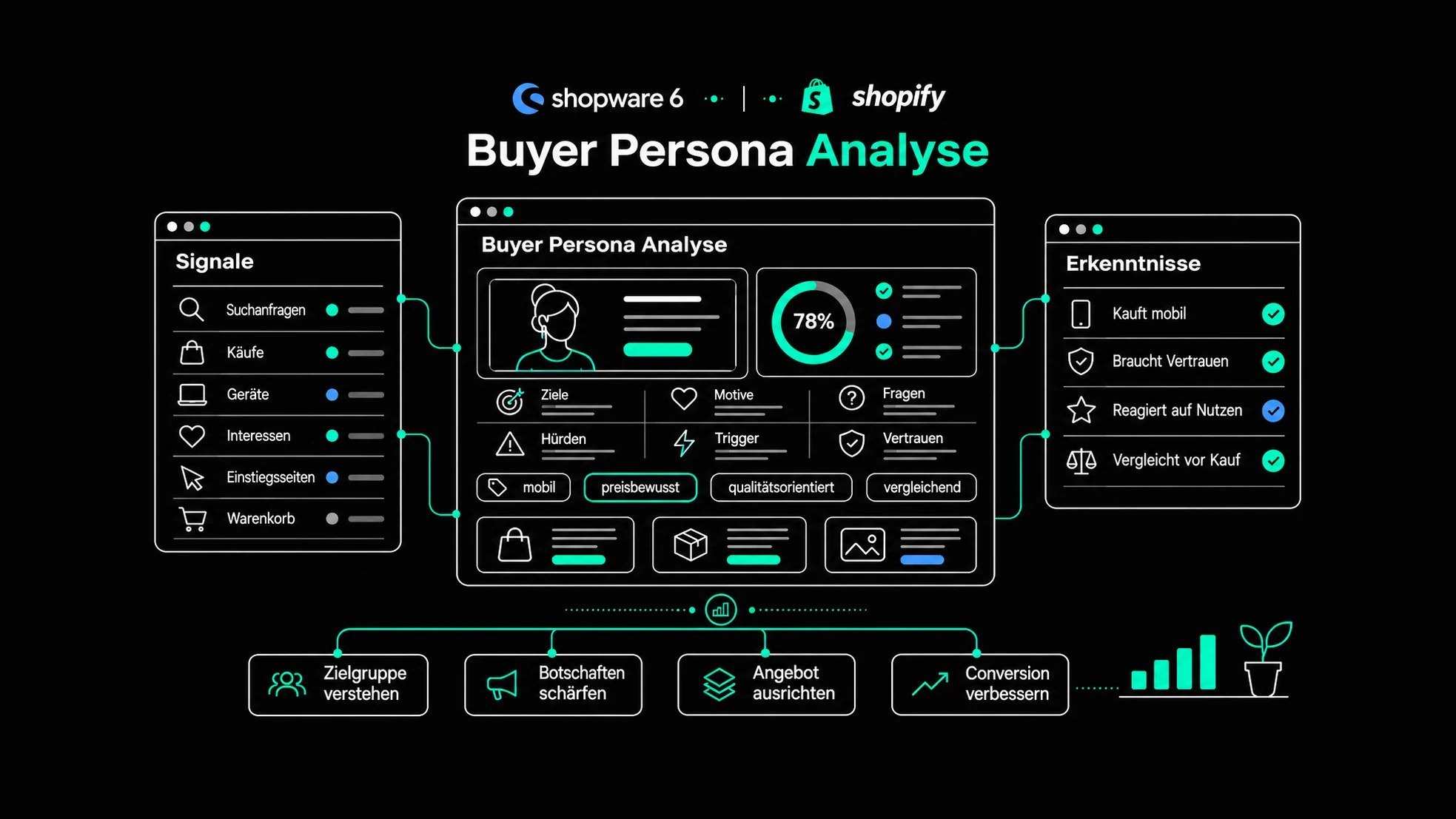
The arboro Customer Insight Sprint combines two AI personas with the data your store already has: search queries, reviews and questions to customer service.
The result is a customer journey analysis with ten measures for one product range, ranked by impact and effort.
Fixed price · two to three weeks · no follow-on contract required
Shopware & Shopify development · Support · Agency switch · Shop migration · SEO/GEO · SEA · AI commerce





“The bait has to appeal to the fish, not to the angler.”
Many online stores are built from the angler's point of view: range, categories, keywords. The Customer Insight Sprint turns the perspective around and asks what your customers want to know before they even think of your product.
Your customers are buying. Just not from you.
The demand is there. Your customers have a problem, ask questions and look for answers. But they don't end up in your store. They end up with whoever answered their questions first. When they buy, they buy there.
The tricky part: your web analytics shows none of this. No bounce, no abandoned cart, no warning. These customers were never in your store. Keyword tools only show the moment when someone already knows what they want to buy. They report small search volumes only roughly or not at all, and anyone who asks by voice search or talks it through with ChatGPT, Claude or Gemini never appears in a keyword list.
You invest in your range, advertising and content. And the moment your customer decides belongs to someone else.
Before the product search
Your customer doesn't yet know they need your product. They have a problem and look for its cause and a solution. Whoever helps them at that point earns their trust long before a product comes into play.
Before the purchase
They are close to buying and have doubts: which material, which size, does it suit my case? If they can't find the answer in your store, they look elsewhere and buy there.
In the Shopware or Shopify store
Your categories follow your inventory system, your customers think in problems. The further apart the two are, the faster the tab with your store gets closed.
More content is rarely the answer.
Usually, two or three pieces of content are missing at exactly the points where your customers decide. The customer journey analysis shows which ones, before more budget goes to the wrong place.
Four steps in two to three weeks
AI personas are not real customers and do not replace a representative survey. They are a tool for quickly playing through possible questions and decision paths. The result only becomes reliable once it is matched against your data.
The sprint is limited to one product range in your Shopware or Shopify store. That keeps it short and the result concrete.
Kick-off: set the focus
Agree on the product range, target groups, business goals, existing insights and available data sources. Result: a clear framework for the sprint.
Form assumptions
Two AI personas play through typical situations: What triggers the search? Which questions come up along the way? What builds trust? Result: personas and decision questions.
Match with data
The assumptions are compared with up to two data sources, such as Search Console, store search, reviews or questions to customer service. Result: confirmed signals and open questions.
Workshop: prioritise measures
The findings are sorted along the customer journey, prioritised by impact, effort and urgency and assessed together. Result: a roadmap with ten measures for your store.
What is proven and what isn't.
Every recommendation in the customer journey analysis carries one of three labels. That way you can always see where the data ends and the assumption begins.
Observed signal
Backed by your data, for example by search queries, reviews or questions to customer service.
Plausible hypothesis
Derived from the AI personas and consistent, but not yet confirmed in your data.
Test before implementing
Check it on a small scale first, for example with an A/B test, before budget goes into implementation.
Michael needs pond liner. Just not yet.
Michael · fictional AI persona
43 · garden owner · wants to fix the problem himself
The keyword: “buy pond liner”
The questions before it:
01 Why is my pond losing water in the first place?
02 Can I find and repair the leak myself?
03 Which liner do I need, and how much of it?
Three questions, three possible ways into the store.
A Shopware store for pond liner is optimised for “buy pond liner”. Michael searches for something else first: he wants to know why his pond is losing water.
By the time he gets to the liner, he has asked three other questions. Each of them could have been his way into your Shopware or Shopify store.
If a competitor answers these questions first, Michael buys the liner there. He never even sees your store.
Recognise the problem
“Why is my pond losing water?”
→ Guide to finding the cause
Weigh up solutions
“Repair or reline?”
→ Decision aid
Choose with confidence
“Which liner, which size?”
→ Quantity calculator, advice, set
Do it yourself
“What else do I need?”
→ Checklist and accessory set
Note: Michael is a fictional AI persona from our talk “From Keywords to People”. The measures are illustrative hypotheses, not results of a real customer study.
Do you know the Michael in your store?
Six questions, answered honestly. The result shows whether the sprint is worthwhile for your store, where your biggest gaps are and what you can do yourself right away.
If you are unsure, choose No. That makes the result more accurate.
0 of 6 answered
Can you name three questions your customers have before they search for your product, off the top of your head?
Do customers find an answer to these questions in your store?
Test, 1 minute: ask ChatGPT, Claude or Gemini about your customers' problem, not about your product. For example: “Why is my pond losing water?” Is your store mentioned?
Do your most important product pages answer your customers' most common question?
Does your team use the questions from emails and phone calls to improve your store texts?
Would you notice if a competitor started answering your customers' questions better from tomorrow?

René Härer leads your Customer Insight Sprint.
René has been responsible for arboro's editorial team for more than ten years, and with it the content of all online marketing projects. Over that time, he has supported well over 70 SEO projects on an ongoing basis.
As a certified manager for AI transformation, he knows what AI personas can do. As a trained historian, he checks every statement for its source. That is exactly the combination a customer journey analysis needs: using AI without believing it blindly.
“An AI persona is not empirical market research. It doesn't deliver the truth about the customer, but it delivers a great many hypotheses about customers. And that is exactly where its strength lies.”
René Härer
Head of Content, arboro GmbH · leading the editorial team for more than ten years · certified manager for AI transformation
From keywords to people.
How do AI personas help you understand search intent? Why does the need to buy often arise long before the product keyword? And what does that mean for SEO, GEO and content in a Shopware or Shopify store?
The narrated talk tells the story through Michael and his garden pond. It also shows where the method stops: an AI persona delivers assumptions, not customer truth.

Where the results of the customer journey analysis come into play
What you get is not a persona profile that ends up in a drawer. The roadmap assigns every measure to an area. So it's clear who can implement it: your team or a service provider like arboro.
SEO and search intent
Recognise pre-purchase questions as search topics and plan content for every stage of the journey.
GEO and AI visibility
Content that answers concrete questions is the prerequisite for AI search systems to use a store as a source at all.
Content and buying advice
Use guides, FAQs and buying advisors where a purchase decision actually hinges.
UX and navigation
Align categories, filters and product pages with the questions customers ask when choosing.
Conversion optimisation
Name the hurdles to a decision and derive tests from them whose impact can be measured.
Store features and product sets
Identify the need for configurators, quantity calculators or product sets. If you wish, arboro's development team handles the technical implementation.
For stores without their own market research budget
A classic study with surveys or in-depth interviews is too expensive and too slow for many small and mid-sized online stores to commission for every product range. A target group analysis usually describes who buys. And many teams create personas once in a workshop, after which they disappear into a folder.
The customer journey analysis does not replace market research. It uses what is already there: search data, reviews, questions to customer service. The AI personas help to organise these signals and make gaps visible.
If a real survey makes sense afterwards, at least you'll know which questions to ask. That goes into the roadmap too, tailored to your Shopware or Shopify store.
The most expensive measure is the one in the wrong place.
A new category structure, a series of guides, a campaign: each of them quickly costs more than this sprint. And each of them fizzles out if it answers questions your customers never ask. The sprint makes sure your next budget lands where your customers actually decide.
Check the bait first, then cast it.
Customer Insight Sprint at a fixed price: €4,900 one-off.
Excl. VAT. Takes about two to three weeks. You pay for a well-founded assessment of one product range. The value lies in the prioritisation: which measures pay off first, and which can wait?
Ready to implement
Every measure in the roadmap is described so that your team or a service provider can work with it.
No follow-on contract required
You decide what you implement in-house, what arboro takes on and what you discard.
Not included
Your own customer interviews, technical implementation and permanent data access are not part of the fixed price.
Suitable for B2B and B2C stores with products that need explaining, a large range or a conversion rate that stagnates despite decent traffic.
Additional product ranges, your own customer interviews, data preparation and implementation of the measures are available separately on request. The schedule assumes that information and data access are provided promptly.
Why the customer journey analysis belongs with arboro.
A roadmap is only worth as much as its feasibility. arboro has been working on online stores for 17 years and brings SEO, GEO, content, UX/CRO and Shopware and Shopify development together in one team. That's why the roadmap only contains measures whose effort can be estimated realistically. If you wish, arboro implements them itself.
Who is responsible for your sprint.
In-house editorial team
Editors who build up knowledge of your industry and your range over months. No freelancer pool, no constant turnover.
Shopware since version 2
E-commerce since 2009, one of the first Shopware partners, today a Shopware Gold Partner and Shopify Partner.
Sales psychology, certified
Our managing director Zoran Artmagic is certified in sales psychology by TÜV Rheinland. Whether a text removes purchase doubts is therefore a top-management matter for us.
Long-term partnership
More than 50% of our clients have been working with us for over eight years.
René Härer
Head of Content

Andra Schmidt
Senior Content Manager

Benjamin Breuer
Senior Content Manager

Emmanuel Zouboulis
Head of SEO/GEO | Authorised Signatory

Daniel Böttcher
SEO/GEO Manager

Sebastian Lörz
Technical Online Marketing
Who works on your copy.
At arboro, only permanently employed senior experts work for you. Our guiding principle: a professional home for experts. It describes who we look for and why these people stay. For you, this means experience that pays off from day one instead of onboarding at your expense. And specialists who take your store seriously and take responsibility for the result.
Editorial and SEO/GEO sit in one team. Whoever writes your copy talks directly to those who implement and measure it.
What connects this team is curiosity. It tests new tools, follows how Google and AI systems evaluate content, and continuously brings that knowledge into your copy. So your content is created to today's standards, not those of three years ago.

Frequently asked questions about the Customer Insight Sprint.
An AI persona is a simulated model of a typical customer situation. It puts itself in your customer's shoes: what problem do they have, what questions do they ask, what do they doubt, and what convinces them in the end? This quickly reveals questions and decision hurdles that never show up in a keyword list.
Important for your decision: an AI persona delivers hypotheses, not customer truth. That's why every insight carries one of three labels:
Observed signal:
Backed by your data, for example by search queries, reviews or questions to customer service.
Plausible hypothesis:
Consistently derived, but not yet confirmed in your data.
Test before implementing:
Check it on a small scale first, before budget goes into implementation.
But the result only becomes reliable once it is matched against your data.
A target group analysis describes who your customers are. The sprint shows what these people want to know before they buy. Industry, age, purchasing power and channels help with targeting. But they don't explain why a visitor leaves your store again or buys from a competitor.
The difference at a glance:
Target group analysis:
Who buys? Demographics, industry and channels. The result is a profile.
Customer Insight Sprint:
What does this person ask, when do they doubt, and where does your Shopware or Shopify store have no answer? The result is ten prioritised measures.
An existing target group analysis is therefore not a substitute but a good starting point. It feeds into the kick-off and makes the sprint even more accurate.
No. The customer journey analysis is a short, structured analysis and strategy process, not a representative study. Classic market research with surveys or in-depth interviews often takes months and costs many times as much. For small and mid-sized stores, that is rarely economical for every single product range.
The sprint takes a more pragmatic route:
Use what is already there:
Search data, reviews and questions to customer service already exist in most stores but are hardly ever analysed.
Get clarity fast:
After two to three weeks, you know where the biggest gaps are and what to do first.
Go deeper where it matters:
If questions arise that only a real survey can answer, that goes into the roadmap, together with the questions you should then ask.
That way you only invest in market research once it is clear what for.
Four things are enough to get started: the product range, your target group, the store URL and a date for the kick-off. The more real signals are added, the more reliable the result becomes.
Helpful for the matching are, for example:
Search data:
Google Search Console or queries from your store search show what your customers actually search for.
The voice of your customers:
Reviews, product ratings and anonymised topics from customer service show what customers have doubts about.
Behaviour in the store:
Entry pages, drop-offs and cart data show where customers get stuck.
The fixed price includes matching with up to two data sources. Which ones is agreed together in advance, and only what you release is used.
Yes. In that case, the customer journey analysis works on the basis of assumptions and publicly available signals. These include, for example, questions in forums and advice portals, answers from AI assistants such as ChatGPT, Claude or Gemini, reviews on marketplaces, and the content of your store and your competitors.
The result clearly labels which assumptions could not be checked against internal data. So you know exactly what you can build on right away and what you should test first.
It often also becomes clear which data you are missing and how you can collect it in future with little effort.
The sprint pays off wherever customers think, compare or hesitate before buying. That applies equally to B2B and B2C stores.
Typical signs that the sprint is worthwhile for your store:
Products that need explaining:
Your customers need advice before they buy, for example on technology, material or application.
A large range:
Many similar products make the decision difficult, and customers don't find the right one.
Decent traffic, weak conversion:
Visitors come, but too few buy, and nobody knows exactly why.
Long decision paths:
There are several steps and many questions between the first problem and the purchase.
The approach works regardless of platform. arboro has the most project experience with Shopware and Shopify, so the measures for these systems are correspondingly concrete.
You don't get a presentation for the drawer, but a roadmap your team or a service provider can work with immediately.
The result at a glance:
Two AI personas:
With situation, motives, questions and doubts, tailored to your product range.
Customer journey map:
All stages from the first problem to the purchase, with the questions and hurdles at every step.
Gap analysis:
Where your store currently has no answer in search, content, navigation and conversion.
Roadmap with ten measures:
Prioritised by impact, effort and urgency, each measure labelled as signal, hypothesis or test.
Final workshop:
90 minutes in which the results are assessed together and the next steps are agreed.
Afterwards, you know what your customers want to know before they buy, and which measures you should tackle first.
The fixed price of €4,900 excl. VAT includes the customer journey analysis and the roadmap, but not the implementation. That is deliberate: you decide freely who implements which measure.
You have three options:
Implement in-house:
Every measure is described so that your own team can work with it directly.
With your service provider:
The roadmap is also clear and actionable for existing agencies or freelancers.
With arboro:
If you wish, arboro handles the implementation, from SEO, GEO and content through conversion optimisation to development in your Shopware or Shopify store.
A follow-on contract is not a condition. The sprint has to be worth it on its own.
Before the project starts, we agree together which sources are released and how they are used sparingly. Your data remains your data.
In concrete terms:
Released sources only:
Only what you explicitly release is used.
Patterns, not people:
Topics and patterns are enough for the analysis. Your customers' names or contact details are not needed.
No unchecked route into AI tools:
Personal or sensitive information does not go into AI tools without an agreed procedure.
The details are agreed on a project basis.
The best fit is the product range where the most revenue is at stake or where customers hesitate most often. That is often not the largest category, but the one where advice, comparison or uncertainty shape the purchase decision.
Good candidates to start with:
High share of revenue:
Every better answer has a direct effect on your revenue here.
Many queries:
Where customer service answers the same questions again and again, the gap is out in the open.
Strategically important:
A new or growing product range in which you want to beat your competitors.
In a free initial consultation, we clarify which product range suits your customer journey analysis and which data is available for it. And if the sprint isn't right for your store, we'll tell you.
Find out which bait your customers really want.
One conversation, an honest assessment and then a clear picture: which product range is worth starting with, and what data is available?