
IP address
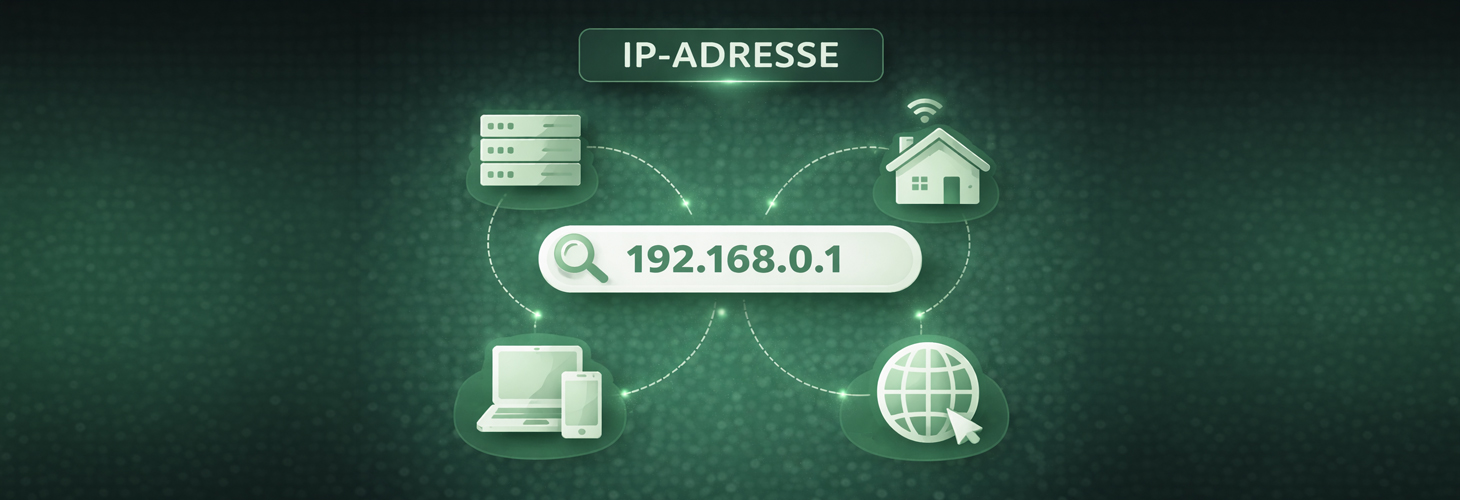
For devices in a network to exchange data, sender and recipient must be uniquely addressable. On the internet, this is done via the IP address (Internet Protocol address). Every device connected to the internet – computer, smartphone, router or server – receives such an address. So that nobody has to remember strings of numbers, the Domain Name System (DNS) translates domain names such as example.com into the server's IP address. A distinction is made between static and dynamic IP addresses: servers running websites and online shops usually have a fixed (static) IP address so that they can be reached reliably. Private connections usually receive dynamic addresses from the internet provider that change regularly. Many websites can also run on one server under the same IP address (shared hosting).
Structure of an IP address
There are two standards. An IPv4 address consists of four numbers between 0 and 255, separated by dots, for example 192.0.2.1. This allows around 4.3 billion addresses – too few for today's number of connected devices. That's why IPv6 was developed: an IPv6 address consists of eight blocks of four hexadecimal characters each, separated by colons, such as 2001:0db8:0000:0000:0000:0000:0000:0001. Consecutive blocks of zeros may be abbreviated with two colons (2001:db8::1). Each address consists of a network part and a device part.
What an IP address reveals – and what it means for data protection and SEO
IP addresses are allocated in blocks by regional registries to internet providers, companies and authorities. As a result, an IP address usually reveals which provider is being used and roughly which country or region a user is in. Websites use this, for example, to point visitors to the right country version or to detect abuse. Precise location is generally not possible. For SEO: the IP address or server location hardly plays a role in Google rankings – domain extension, language and hreflang annotations are more important for country targeting. Shared hosting with other websites on the same IP is generally not a problem either.
In terms of data protection, IP addresses are considered personal data in the EU, as the European Court of Justice confirmed in 2016; Swiss data protection law also treats them as such in many cases. Websites and online shops may therefore only store and process them if there is a legal basis for doing so – for example for server security – and must state this in their privacy policy. Many analytics tools such as Google Analytics 4 therefore don't store IP addresses.