Magento migration with a Shopify Partner
Migrate from Magento to Shopify and finally hand over the technology.
Many Magento merchants do not want to fund another upgrade project. They want to look after range, marketing and customers, not servers, security holes and module conflicts. Shopify takes exactly that off your plate.
There is no official tool from Magento to Shopify. arboro has migrated more than 25 Magento stores, transfers the data via service providers, import apps or the Shopify API, and builds a target in the new Shopify structure for every old address.
An honest view on whether Shopify fits you





The essentials in one minute.
The short version for management, as of November 2026.
Why Magento merchants move to Shopify.
Since Adobe Commerce 2.4.4, every release line has three years of regular support. For 2.4.6 it ended in August 2026, for 2.4.7 it ends in May 2027. With Shopify, that question disappears entirely.
No hosting, no upgrades
Shopify handles servers, security and updates. No maintenance window, no upgrade project every three years, no security hole at the weekend.
New ideas in days
Many features come from apps or Shopify itself. What was a developer project in Magento is often a setting.
International stores with Markets
Magento store views are mapped to Shopify Markets, with languages, currencies and prices per country.
More channels from one inventory
Online store, social commerce, marketplaces and point of sale all draw on the same inventory.
When Shopify is not the right choice.
Shopify is strong when your processes follow the standard. It gets expensive when you rebuild special logic with many apps that cost money every month and get in each other's way.
Typical cases: complex customer prices from the ERP, multi-level approvals, products with more than three independent options, or custom checkout logic without Shopify Plus. Then Shopware 6 is often the better foundation.
Honest, because arboro builds both
arboro is a Shopify Partner and a Shopware Gold Partner. If the analysis shows your business runs better on Shopware, you hear it in the first call.
How urgent is your switch?
Six questions, one minute. A yes means this point is under control in your store.
0 of 6 answered
Does your store run on Magento 2.4.8 or newer?
Do your Magento upgrades go through without a project lasting several weeks?
Do you have at least two developers who really know your Magento store?
Do you know which of your Magento modules are still needed and who maintains them?
Are hosting, licences and maintenance in healthy proportion to your online revenue?
Can your team launch a new campaign page without a developer ticket?
Shopify or Shopware 6? Your decision briefing.
This page describes the route to Shopify. Whether it is the right one for you is what the calculator shows. If it recommends Shopware 6, that is an honest result, and you will hear the same from arboro.
Shopware 6 or Shopify? Your decision briefing
16 questions, plus two follow-ups depending on your answers, under four minutes. At the end you receive a briefing with recommendation, reasons, risks, project complexity, migration risk, cost guide values and the points to clarify before deciding. Nothing is stored unless you send it.
Step 1 of 6
Business model
How you sell
What Magento becomes in Shopify.
The overview every Shopify plan should start with. Whatever is not settled here comes back to bite you during the import.
| Area | Magento | Shopify |
|---|---|---|
| Websites and store views | Websites with their own domain, store views for languages | Markets with languages, currencies, domains and prices per country |
| Attributes | Attribute sets per product type | Metafields and metaobjects, mapped in advance |
| Configurable products | Any number of configurable attributes | Up to three options and, since October 2025, up to 2,048 variants per product |
| Bundle and grouped products | Bundle and grouped products as standard | Bundles via the Shopify app or third-party apps |
| Customer groups and tier prices | Customer groups, tier prices | B2B catalogues, volume pricing and company accounts, more configuration with Shopify Plus |
| Cart price rules | Cart price rules with coupons | Discounts as standard, special logic via Shopify Functions or apps |
| Inventory | Multi-Source Inventory | Multiple locations as standard |
| Search and filters | OpenSearch with layered navigation | Search & Discovery or search apps, filters via metafields |
| Content | CMS pages, CMS blocks, Page Builder | Pages, blog and theme sections in the online store editor |
| Checkout | Freely customisable | Standard checkout, deeper customisation mainly with Shopify Plus |
| Customer passwords | Magento hashing | Not transferred. Customers sign in with a code sent to their email address |
| URLs | URL rewrites, often with a .html suffix | Fixed paths /products/, /collections/, /pages/, /blogs/. Every old address needs a redirect |
Magento
- Websites and store views
- Websites with their own domain, store views for languages
- Attributes
- Attribute sets per product type
- Configurable products
- Any number of configurable attributes
- Bundle and grouped products
- Bundle and grouped products as standard
- Customer groups and tier prices
- Customer groups, tier prices
- Cart price rules
- Cart price rules with coupons
- Inventory
- Multi-Source Inventory
- Search and filters
- OpenSearch with layered navigation
- Content
- CMS pages, CMS blocks, Page Builder
- Checkout
- Freely customisable
- Customer passwords
- Magento hashing
- URLs
- URL rewrites, often with a .html suffix
Shopify
- Websites and store views
- Markets with languages, currencies, domains and prices per country
- Attributes
- Metafields and metaobjects, mapped in advance
- Configurable products
- Up to three options and, since October 2025, up to 2,048 variants per product
- Bundle and grouped products
- Bundles via the Shopify app or third-party apps
- Customer groups and tier prices
- B2B catalogues, volume pricing and company accounts, more configuration with Shopify Plus
- Cart price rules
- Discounts as standard, special logic via Shopify Functions or apps
- Inventory
- Multiple locations as standard
- Search and filters
- Search & Discovery or search apps, filters via metafields
- Content
- Pages, blog and theme sections in the online store editor
- Checkout
- Standard checkout, deeper customisation mainly with Shopify Plus
- Customer passwords
- Not transferred. Customers sign in with a code sent to their email address
- URLs
- Fixed paths /products/, /collections/, /pages/, /blogs/. Every old address needs a redirect
Six mistakes that make Magento to Shopify migrations expensive.
From more than 25 Magento migrations: this is where revenue is lost if nobody has it on the list.
Forgotten addresses
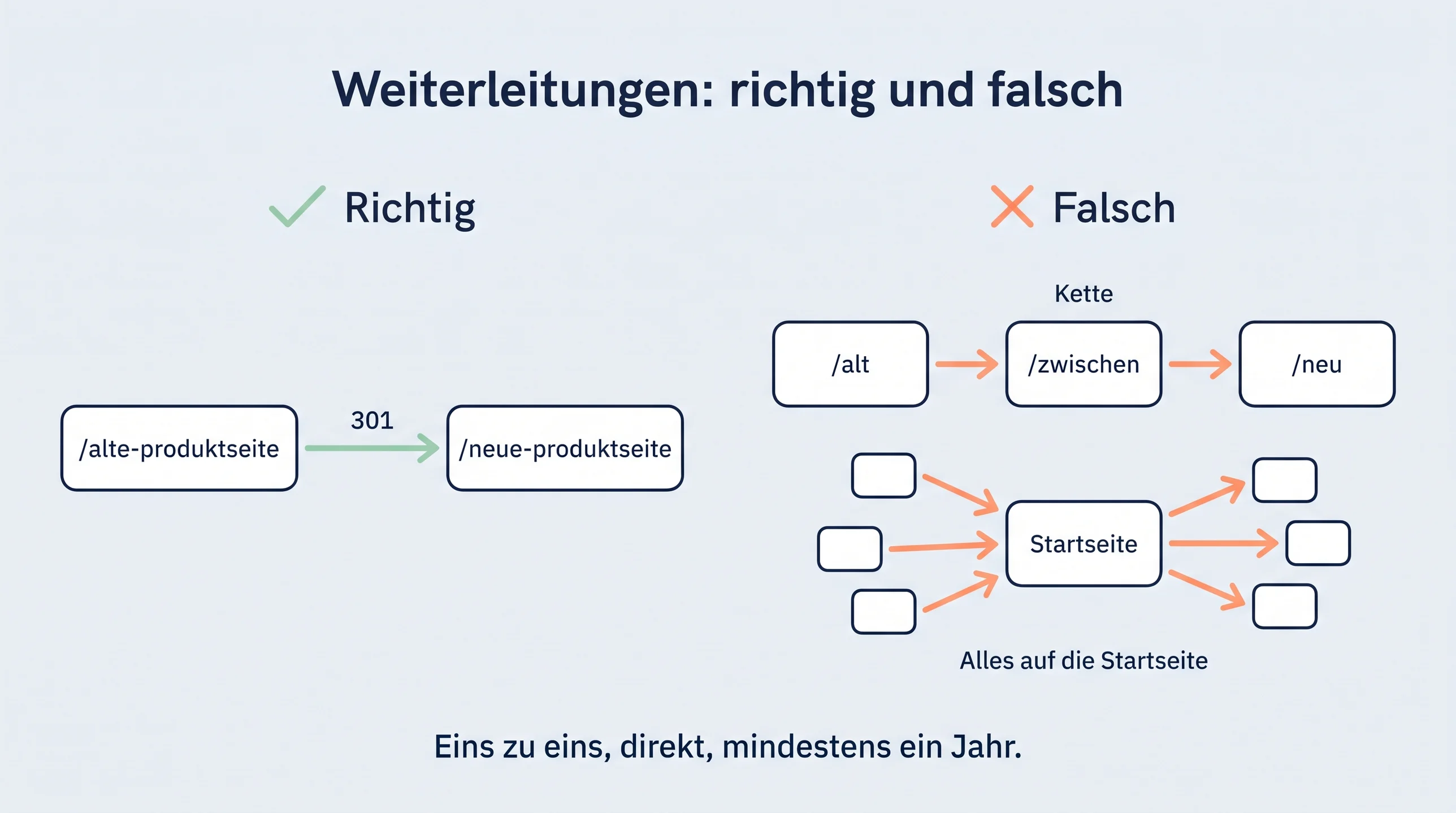
Magento creates product URLs with and without the category path and for every simple product. Shopify only knows /products/. Every old variant needs a target, large lists come in by CSV import.
More than three options
Products with four or more independent options do not fit Shopify's model. They are split or handled with an options app, with consequences for filters and feeds.
App costs that grow with revenue
Booking an app for every Magento module is convenient and expensive. Before the project, it is clear which apps are needed and what they cost every month.
Images in Google Image Search
Product images from /media/catalog/product/ move to the Shopify CDN. If they bring visitors, losing them belongs in the plan.
The surprised loyal customer
Without a customer email before go-live, the loyal customer looks for his password. With the email, he knows that signing in by code is now even easier.
Additional transaction fees
External payment providers alongside Shopify Payments cost an extra fee per order at Shopify. That belongs in the five-year calculation.
The process in four phases.
The duration depends mainly on interfaces, B2B and design. The exact schedule follows the inventory.
The Monday after go-live.
Your team arrives at the office, and there is no server that crashed overnight and no security update to install. The weekend's orders are in, the stock levels are right.
A loyal customer finds his favourite product via his old bookmark, signs in with a code and orders as always. Your marketing team launches the next promotion the same day, because nobody needs to write code for it any more.
What it is about
Shopify does not sell you technology, it sells you time. The migration decides whether you have that time from day one or only after weeks of rework.
The calculation over five years.
Shopify saves hosting and upgrades. In return, plan, apps and possibly transaction fees are added. The comparison is drawn up before your decision, not after.
| Cost block | Magento / Adobe Commerce | Shopify |
|---|---|---|
| Licence | Open Source free, Adobe Commerce with a revenue-based licence | Monthly Shopify plan, Shopify Plus for high volume, deeper B2B and checkout customisation |
| Hosting and security | Own servers, search, cache, security updates | Included in the plan |
| Upgrades | New release line every three years | None, Shopify updates continuously |
| Extensions | Module licences and maintenance | App subscriptions, often monthly or revenue-based |
| Payment | Payment provider fees | No additional transaction fee with Shopify Payments, external providers cost extra |
Magento / Adobe Commerce
- Licence
- Open Source free, Adobe Commerce with a revenue-based licence
- Hosting and security
- Own servers, search, cache, security updates
- Upgrades
- New release line every three years
- Extensions
- Module licences and maintenance
- Payment
- Payment provider fees
Shopify
- Licence
- Monthly Shopify plan, Shopify Plus for high volume, deeper B2B and checkout customisation
- Hosting and security
- Included in the plan
- Upgrades
- None, Shopify updates continuously
- Extensions
- App subscriptions, often monthly or revenue-based
- Payment
- No additional transaction fee with Shopify Payments, external providers cost extra

Florian Gronau
Head of Development / Authorised Signatory

Christopher Wagner
Senior Software Engineer / Technical Lead

Dirk Persky
Head of Shop Support

Alexandra Kuhn-Spannbauer
Senior E-Commerce Project Manager

Susi Streitberger
Senior Frontend Developer

Dominic Schmassmann
Senior Full-Stack Developer

Patrizia Hammann
Senior Full-Stack Developer

Karl-Heinz Harris
Senior Backend Developer
Your Shopify team for the move.
Permanently employed senior developers for Shopify themes, apps and interfaces, plus SEO specialists for the redirect concept and a dedicated shop support team.
More than 25 Magento migrations stand behind this team. Work happens in a development store, and the new store only goes live after complete testing.
What the move costs.
Sources, as of November 2026: Adobe: Released versions · Adobe: Lifecycle policy · Shopify: 2,048 variants per product · Shopify Help: URL redirects
Frequently asked questions about migrating from Magento to Shopify
No. The data is transferred via migration service providers, import apps or the Shopify API. A test migration with your real data shows which route fits.
No, but they no longer need them. At Shopify, sign-in works with a code sent to the email address. Customer data and order history are transferred.
Almost all of them change. Shopify has fixed paths. Every old address therefore gets a redirect to the matching new target, tested before go-live.
Up to 2,048 variants and at most three options per product. Products with more independent options are split or handled with an options app.
Only for high volume, deeper checkout customisation, extensive B2B or several stores. Many former Magento merchants start on a regular plan.
With complex B2B, deep ERP logic and when you need full control over URLs and data. The calculator on this page shows within minutes where your requirements point.
The inventory of your store shows that. You then receive a quote at a fixed price or based on effort, calculated at €150 per hour excl. VAT.
More routes to Shopware or Shopify.
All migrations at a glance on the shop migration page.