
Shopware to Shopify with a partner of both systems
Switch from Shopware to Shopify, with an agency that would also advise against it.
After years with Shopware, some merchants want to get rid of running the technology: no hosting, no updates, no plugin conflicts, less dependence on developers. Whether Shopify is the right answer can be settled before the project, not afterwards.
arboro has been a Shopware Gold Partner since 2009 and is a Shopify Partner. The team built many of the Shopware stores arboro is responsible for itself. If arboro still recommends Shopify, it is because it suits your business. And if not, you will hear that too.
An honest view on whether switching pays off
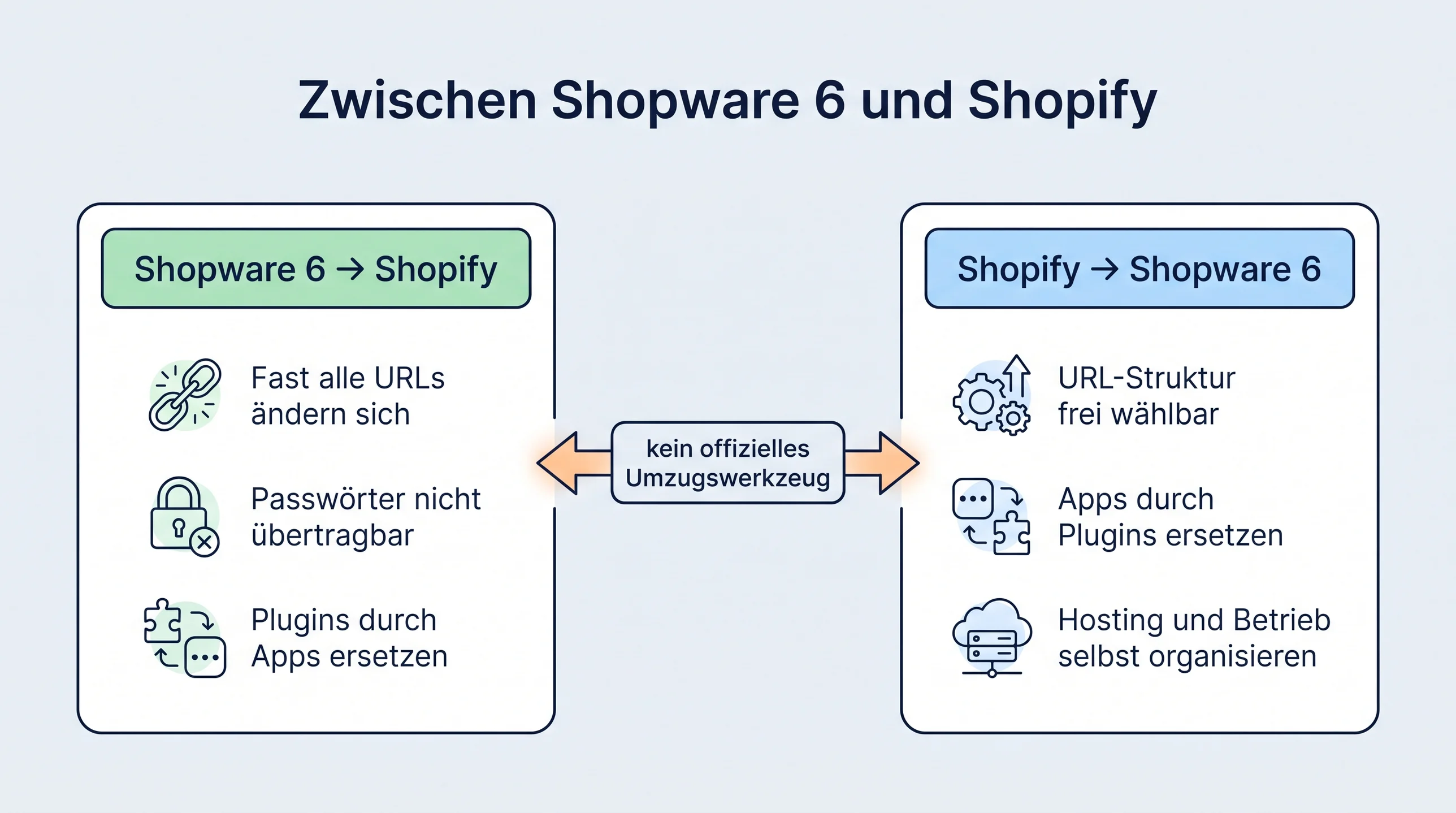





The essentials in one minute.
For managing directors facing the decision. As of November 2026.
Good reasons for Shopify.
A switch pays off when your processes follow the standard and running and developing the store cost more than they bring.
Hand over the technology
Shopify takes care of hosting, security updates and version changes. Your team focuses on range, brand and marketing.
Shopware 5 has no future
No vendor updates since July 2024. Anyone who has to rebuild anyway checks whether Shopify fits instead of Shopware 6.
Social, marketplaces, retail
Shopify connects online store, social commerce, marketplaces and point of sale with one inventory. A strong argument for many brands.
A checkout customers know
The Shopify checkout with Shop Pay is familiar to many customers and is developed further by Shopify, with no effort on your side.
To be honest: when you should stay on Shopware.
Shopware 6 is stronger when your business lives on special logic: customer prices from the ERP, approvals, budgets, complex shipping rules, products with many options, or full control over URLs and data.
Shopify can rebuild much of this with apps and Shopify Plus. That then costs money every month and makes the store dependent on several vendors. In such cases, arboro advises against switching.
Maybe a new agency is enough
Often the problem is not Shopware but how the store has been developed and maintained so far. Then switching agencies is the smaller step.
Does Shopify suit your business?
Six questions, one minute. A yes means this point speaks for Shopify.
0 of 6 answered
Do your prices, discounts and shipping rules largely follow the standard?
Do your products manage with at most three options?
Do you mainly sell to consumers or with simple B2B rules?
Do you want to hand over hosting, updates and security entirely?
Can you use Shopify Payments as your main payment provider?
Are social commerce, marketplaces or a point of sale important to you?
Shopify or Shopware 6? Your decision briefing.
The calculator rates your requirements for both systems. If it points to Shopware 6, that is an honest result, and arboro will tell you the same.
Shopware 6 or Shopify? Your decision briefing
16 questions, plus two follow-ups depending on your answers, under four minutes. At the end you receive a briefing with recommendation, reasons, risks, project complexity, migration risk, cost guide values and the points to clarify before deciding. Nothing is stored unless you send it.
Step 1 of 6
Business model
How you sell
What Shopware becomes in Shopify.
The overview every plan starts with. Every row is a decision before the first data import.
| Area | Shopware 6 | Shopify |
|---|---|---|
| Sales channels | Several channels with their own domains, languages, currencies and ranges | Markets with languages, currencies and prices per region, separate stores for very different presences with Shopify Plus |
| Properties and custom fields | Properties for filters, custom fields for everything else | Metafields and metaobjects, filters via Search & Discovery |
| Variants | Any number of properties as variants | At most three options and up to 2,048 variants per product |
| Rule Builder | Rules for prices, shipping, payment and promotions | Discounts as standard, special logic via Shopify Functions or apps |
| Flow Builder | Automations on events | Shopify Flow |
| Shopping Experiences | Pages built from blocks, maintained by the team | Theme sections and metaobjects in the online store editor |
| Customer groups | Groups with their own prices and rules | Customer tags, B2B company accounts and catalogues, more configuration with Shopify Plus |
| Plugins | Extensions from the Shopware Store or custom development | Apps from the Shopify App Store, often as monthly subscriptions |
| Payment | PayPal, Mollie, Payone, Unzer and others without a platform surcharge | Shopify Payments without surcharge, external providers with a transaction fee per plan |
| URLs | Freely configurable SEO URL templates | Fixed paths /products/, /collections/, /pages/, /blogs/. Every old address needs a redirect |
| Customer passwords | Stored passwords | Not transferable, sign-in by code sent to the email address |
Shopware 6
- Sales channels
- Several channels with their own domains, languages, currencies and ranges
- Properties and custom fields
- Properties for filters, custom fields for everything else
- Variants
- Any number of properties as variants
- Rule Builder
- Rules for prices, shipping, payment and promotions
- Flow Builder
- Automations on events
- Shopping Experiences
- Pages built from blocks, maintained by the team
- Customer groups
- Groups with their own prices and rules
- Plugins
- Extensions from the Shopware Store or custom development
- Payment
- PayPal, Mollie, Payone, Unzer and others without a platform surcharge
- URLs
- Freely configurable SEO URL templates
- Customer passwords
- Stored passwords
Shopify
- Sales channels
- Markets with languages, currencies and prices per region, separate stores for very different presences with Shopify Plus
- Properties and custom fields
- Metafields and metaobjects, filters via Search & Discovery
- Variants
- At most three options and up to 2,048 variants per product
- Rule Builder
- Discounts as standard, special logic via Shopify Functions or apps
- Flow Builder
- Shopify Flow
- Shopping Experiences
- Theme sections and metaobjects in the online store editor
- Customer groups
- Customer tags, B2B company accounts and catalogues, more configuration with Shopify Plus
- Plugins
- Apps from the Shopify App Store, often as monthly subscriptions
- Payment
- Shopify Payments without surcharge, external providers with a transaction fee per plan
- URLs
- Fixed paths /products/, /collections/, /pages/, /blogs/. Every old address needs a redirect
- Customer passwords
- Not transferable, sign-in by code sent to the email address
The calculation over five years.
Shopify saves hosting, updates and part of the development. In return, plan, apps and possibly transaction fees are added. Both are compared with your numbers before you decide.
| Cost block | Shopware 6 | Shopify |
|---|---|---|
| Licence | Community Edition free, from €1m revenue in 365 days the Fair Usage Policy applies, Rise currently from €600 per month | Monthly plan, Shopify Plus from USD 2,300 per month on a three-year term |
| Hosting and updates | Servers, updates and security in your own hands or with your partner | Included in the plan |
| Extensions | Plugins mostly with annual licences | App subscriptions, often monthly or revenue-based |
| Payment | Only the payment provider's fees | No surcharge with Shopify Payments, otherwise 2% (Basic), 1% (Grow), 0.6% (Advanced), 0.2% (Plus) |
| Development | Own logic via plugins, full freedom | Whatever the standard and apps cannot do becomes costly |
Shopware 6
- Licence
- Community Edition free, from €1m revenue in 365 days the Fair Usage Policy applies, Rise currently from €600 per month
- Hosting and updates
- Servers, updates and security in your own hands or with your partner
- Extensions
- Plugins mostly with annual licences
- Payment
- Only the payment provider's fees
- Development
- Own logic via plugins, full freedom
Shopify
- Licence
- Monthly plan, Shopify Plus from USD 2,300 per month on a three-year term
- Hosting and updates
- Included in the plan
- Extensions
- App subscriptions, often monthly or revenue-based
- Payment
- No surcharge with Shopify Payments, otherwise 2% (Basic), 1% (Grow), 0.6% (Advanced), 0.2% (Plus)
- Development
- Whatever the standard and apps cannot do becomes costly
Shopify prices according to Shopify, as of November 2026, plus taxes.
Six mistakes that make the move to Shopify expensive.
From projects in both directions: this is where revenue is lost if nobody has it on the list.
Forgotten addresses
Shopware creates URLs for products, variants, categories, manufacturers and Shopping Experiences. Shopify only knows fixed paths. If one group is missing from the redirect plan, visitors land on the error page.
Category texts without a home
SEO texts on categories and Shopping Experiences often carry the rankings. In Shopify they become collection descriptions and theme sections, and somebody has to plan that.
Underestimated Rule Builder logic
Shipping costs by weight and region, discounts by customer group, payment methods by cart: every rule is checked individually and rebuilt in Shopify or deliberately dropped.
The wrong payment provider
Staying with the previous provider out of habit costs extra on every order at Shopify. With €2m revenue on the Grow plan, that is €20,000 a year.
Several currencies without Shopify Payments
Local-currency prices via Markets usually require Shopify Payments. If you depend on an external provider, check this before deciding.
An app for every plugin
Convenient, but expensive. Before the project starts, it is clear which features Shopify brings, which app is really needed and what all apps together cost per month.
Already done: the Horsch store.
Horsch, a family business for shoes in extra-large and extra-small sizes, ran with arboro first on Shopware 4, then on Shopware 5, and then moved to Shopify with arboro. Other merchants went from Shopware 5 to Shopware 6. Both decisions were right because they followed the business model.
The process in four phases.
The duration depends mainly on rules, interfaces and design. The exact schedule follows the inventory.
The Monday after go-live.
No server that caused trouble overnight, no plugin update waiting for the next Shopware release. The weekend's orders are in, the stock levels are right.
Your loyal customer finds her favourite product via her old bookmark, signs in with a code and pays with Shop Pay in two clicks. Your marketing team puts the new promotion online itself, in the theme editor, the same morning.
What it is about
Shopify sells you time. The migration decides whether you have that time from day one or only after weeks of rework.

Florian Gronau
Head of Development / Authorised Signatory

Christopher Wagner
Senior Software Engineer / Technical Lead

Dirk Persky
Head of Shop Support

Alexandra Kuhn-Spannbauer
Senior E-Commerce Project Manager

Susi Streitberger
Senior Frontend Developer

Dominic Schmassmann
Senior Full-Stack Developer

Patrizia Hammann
Senior Full-Stack Developer

Karl-Heinz Harris
Senior Backend Developer
Your team for both worlds.
Permanently employed senior developers for Shopware and Shopify, SEO specialists for the redirect concept and a dedicated shop support team. Head of Development is Florian Gronau.
Because arboro develops both systems, no recommendation comes from self-interest.
What the switch costs.
Sources, as of November 2026: Shopify: Pricing · Shopify Plus: Pricing · Shopify Help: Fees · Shopify: 2,048 variants · Shopify Help: Redirects
Frequently asked questions about migrating from Shopware to Shopify
Not an official one. The data is transferred via migration apps, CSV imports or the Shopify API. A test migration shows which route fits.
Almost all of them change. Shopify has fixed paths. Every old address gets a redirect to the matching new target, large lists come in by CSV import.
No, but they no longer need it. Sign-in works with a code sent to the email address. Customer data and order history are transferred.
Each one is checked individually. Shopify covers discounts and simple rules as standard, special logic via Shopify Functions or apps. Whatever nobody needs any more is dropped.
No additional ones with Shopify Payments. With external payment providers, Shopify charges 2% per order on Basic, 1% on Grow, 0.6% on Advanced and 0.2% on Plus.
For simple B2B cases yes, with more options in Shopify Plus. With complex approvals, customer prices from the ERP and many special rules, Shopware 6 is usually the better choice.
The inventory shows that. On that basis you receive a fixed-price or time-and-materials quote at €150 per hour excl. VAT.
More routes to Shopware or Shopify.
All migrations at a glance on the shop migration page.