

UCP and agentic commerce: what Shopware and Shopify merchants need to know and do now
When this article first appeared, agentic commerce was mainly an announcement: new protocols, waiting lists, tests in the US. Today, the picture looks different. Some expectations have been met, others have failed, and Shopware and Shopify merchants now have very concrete ways to take part. This article summarises where things stand, from the perspective of a team that builds Shopware and Shopify stores and measures their visibility in AI systems.
The key points:
Discovery works, buying in the chat hardly does yet. AI assistants recommend products every day. In Germany, however, purchases are still almost always made in the merchant’s store.
UCP is currently the most important standard for buying via AI agents. OpenAI has withdrawn checkout directly in ChatGPT and now uses its ACP protocol mainly for product discovery.
Shopify merchants are in automatically. Their products are served by default to ChatGPT, Copilot, Google AI Mode, Gemini and Meta.
Shopware merchants need to take action. The official Agentic Commerce extension brings UCP into the store per sales channel.
Data decides. Whoever has clean product data, clear prices and delivery terms gets recommended. Whoever doesn’t gets passed over.
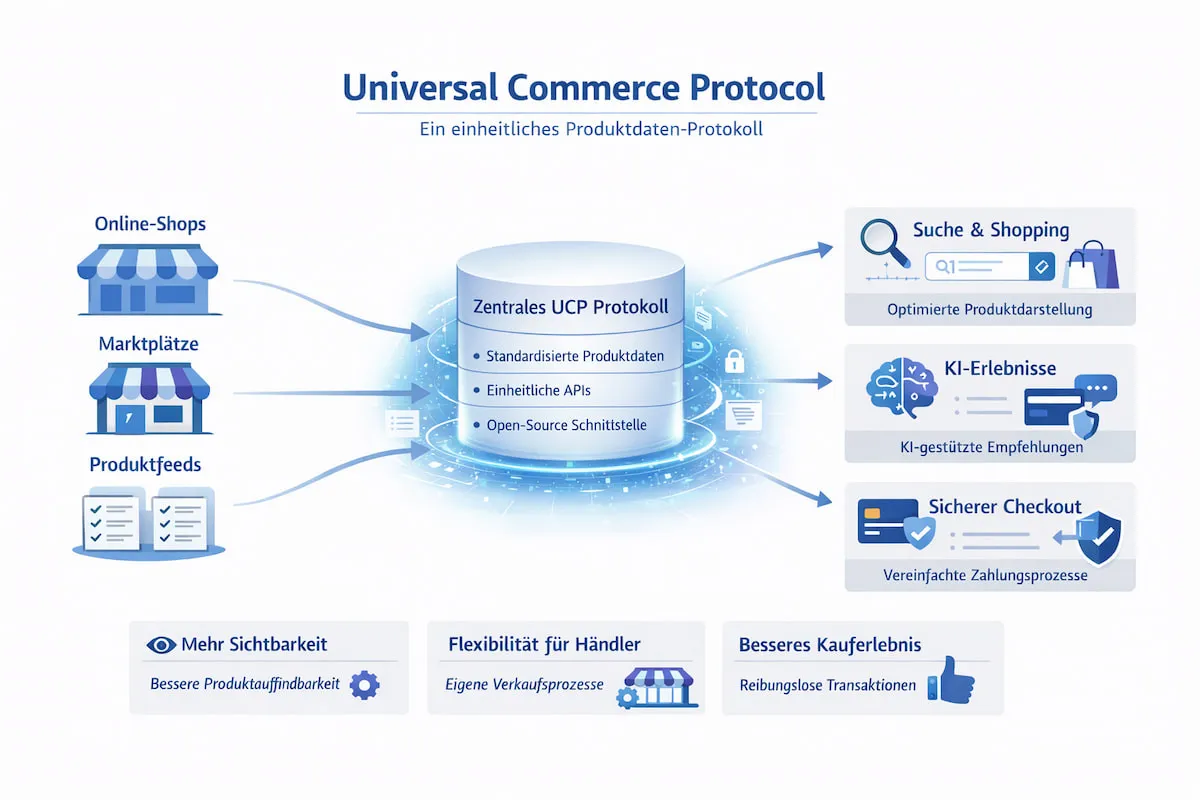
What agentic commerce means
Agentic commerce describes purchases in which an AI doesn’t just advise, but acts. A customer tells their assistant: “I need a suitcase for hand luggage, light, under 150 euros, delivered by Friday.” The agent searches for suitable products, compares merchants, checks delivery times and reviews and suggests a selection. In the next step, it puts the product in the cart and completes the purchase once the customer has agreed.
For merchants, this shifts the decisive question. It used to be: does the customer find my store? Today it is: does the agent understand my products well enough to recommend them, and can it buy from me? For this to work, agent and store need a common language. That is exactly what the protocols are for.
The protocols: UCP, ACP and what goes with them
The Universal Commerce Protocol (UCP) was developed by Google together with Shopify and other retail and payment companies and presented in January 2026. It is an open standard that covers the whole chain: from discovery through cart and checkout to the order afterwards. A store publishes what it can do at the address /.well-known/ucp, and every agent that speaks UCP then knows how to buy from that store. The merchant remains the customer’s contractual partner and keeps the customer relationship.
The Agentic Commerce Protocol (ACP) was published by OpenAI and Stripe in September 2025. It initially powered Instant Checkout in ChatGPT, buying directly in the chat. OpenAI withdrew this in March 2026. Since then, ChatGPT has used ACP mainly for product discovery: product data, images, prices and comparisons appear in the chat, and the purchase happens at the merchant.
Then there are building blocks that work in the background: the Model Context Protocol (MCP), through which AI assistants access tools and data, the Agent-to-Agent protocol (A2A) for agents working together, and the payment standards of the major card providers, which let an agent pay securely on behalf of a customer.
| UCP (Google, Shopify and partners) | ACP (OpenAI and Stripe) |
Introduced | January 2026 | September 2025 |
Focus | the whole chain from search to order | product data and product discovery in ChatGPT |
Buying in the AI assistant | in Google AI Mode and Gemini, so far in the US, Canada and Australia | in-chat purchase discontinued in March 2026, purchases happen in the store |
Where it is used | Google AI Mode, Gemini, and via Shopify other assistants too | ChatGPT |
Merchant remains contractual partner | yes | yes |
What merchants need now | a UCP-capable store and clean data in Merchant Center | clean, structured product data |
You don’t have to choose one protocol. If you keep your data clean and support UCP, you are prepared for the most important assistants.
The most important developments
January 2026: Microsoft launches Copilot Checkout, and customers buy directly in the Copilot conversation. Google presents UCP.
March 2026: OpenAI withdraws Instant Checkout in ChatGPT and refocuses ChatGPT on product discovery. Visa launches its programme for agentic payments in Europe first.
24 March 2026: Shopify announces Agentic Storefronts. Products from Shopify merchants are served in ChatGPT, Copilot, Google AI Mode and Gemini.
May 2026: Mastercard reports the first payment executed by an AI agent in Germany.
In the course of 2026: Shopware releases an official UCP connection with the Agentic Commerce extension.
4 September 2026: Shopify stores publish their UCP profile by default.
The most important lesson from these developments: buying directly in the chat is catching on more slowly than announced. Product discovery via AI, on the other hand, has long been part of everyday life. If you don’t appear there, you lose customers before they even visit a store.
Where Germany, Austria and Switzerland stand
For merchants in the German-speaking region, the situation is two-sided. Recommendations by AI assistants work here just as they do in the US. ChatGPT, Copilot, Gemini, Perplexity and Claude advise German customers every day and name products and stores. Direct purchasing in the assistant, on the other hand, has not arrived yet: checkout in Google AI Mode is not available in Germany, and direct purchasing in Copilot is so far reserved for customers in the US.
The payment side, however, is already there. Stripe offers its tools for agentic payments in Germany too, and Visa and Mastercard have launched their programmes in Europe. When checkout in the assistant arrives, the infrastructure is ready.
In practice, this means: build visibility now and prepare the technical connection now, so that the store is there on the first day buying in the assistant starts here too.
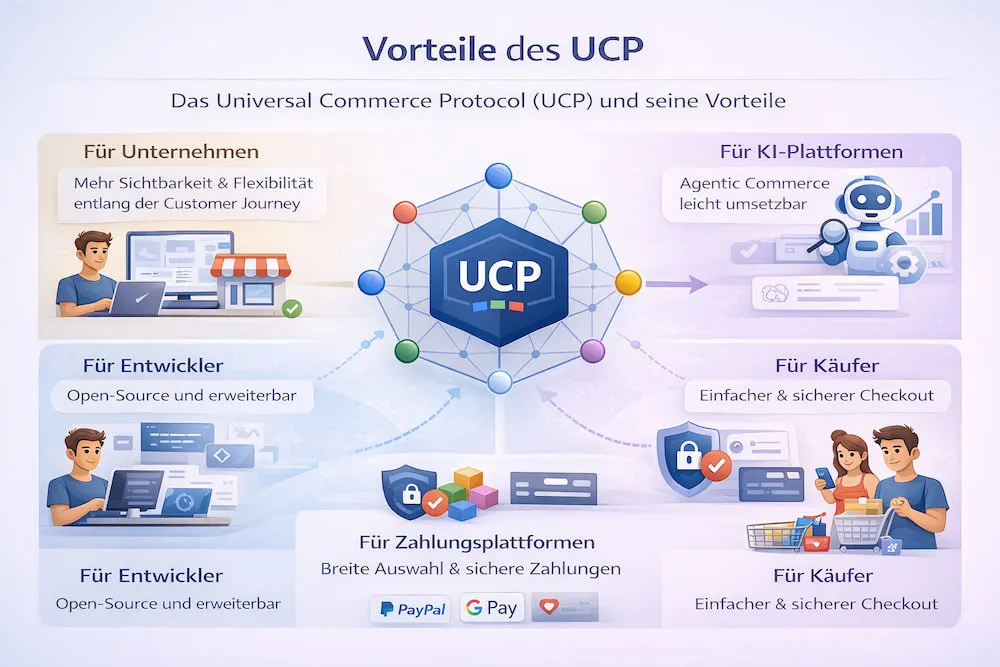
Shopify: you’re already in, but are you steering it?
At Shopify, agentic commerce isn’t a project, it’s a setting. Via Agentic Storefronts, the products of eligible stores are served by default to ChatGPT, Microsoft Copilot, Google AI Mode and Gemini as well as Meta. Control sits in the admin under sales channels. Google AI Mode and Gemini receive the products from Merchant Center. The Google & YouTube app connects a store with one language and one domain to it. With several languages or domains, such as a German and an English store, a feed tool is the reliable solution.
Because this happens automatically, the real work is something else: the data has to be good enough for an agent to prefer your product over another. Typical problem areas in Shopify stores are:
Variants without their own data: sizes and colours without their own GTIN, image and stock level. An agent then cannot say reliably whether exactly this variant is available.
Important information only in the description: material, dimensions or compatibility are in the description but not in structured fields or metafields. For agents, such information is hard to read reliably.
Unclear terms: shipping costs, delivery time and returns are not stated unambiguously. These are exactly the points agents compare first.
No look at the reporting: many merchants don’t know whether and where their products appear in AI channels and what comes of it.
More on the platform’s peculiarities under Shopify SEO.
Shopware: taking action with the Agentic Commerce extension
Shopware takes a different route. Nothing is switched on automatically, but the merchant keeps full control. The official Agentic Commerce extension brings three building blocks into the store:
UCP per sales channel: In the Agentic Commerce tab of a storefront or headless sales channel, you set whether and how the store offers UCP. The profile then appears at /.well-known/ucp.
AI-readable files: such as a machine-readable catalogue that shows agents what the store offers.
MCP: From Shopware 6.7, AI assistants can work directly with the store via the Model Context Protocol.
The extension is still young and evolving quickly. That is exactly why a clean setup pays off: payment methods must be mapped to the UCP payment handlers, shipping and taxes represented correctly, and the flow tested with real agents before it is released to customers. This option doesn’t exist for Shopware 5. If you are still on Shopware 5, you will find the options on the page about migrating from Shopware 5.
The technical foundations for Shopware stores are described on Shopware SEO.
What AI agents need from your store
Regardless of the store system, the same things decide whether an agent recommends your store and can buy there:
Complete product data: unique identifiers such as GTIN, brand, dimensions, material, compatibility and area of use in structured fields, not just in the text.
[Structured data](sd) on product pages: price, availability, shipping, returns and reviews in machine-readable form.
Clear terms: shipping costs, delivery time and return rules unambiguous and the same everywhere.
Current prices and stock: an agent that recommends a product that then turns out to be unavailable will trust that store less next time.
Access for the right crawlers: the AI providers’ search crawlers are allowed to fetch the store. What this looks like in robots.txt is shown in the article on robots.txt for Shopware and Shopify. Which AI crawlers your store allows today is shown by the free robots.txt Checker.
Trust from outside: reviews, mentions and presence on comparison sites feed into the selection. More on this under price comparison sites and Generative Engine Optimization.
The roadmap: agentic ready in three steps
Step 1: Measure where you stand. What do ChatGPT, Gemini, Copilot, Perplexity and Claude answer today to your customers’ questions, and does your store appear? Is it technically readable for agents? The free Agentic Commerce Scanner checks the technical side in a few minutes. Mentions in AI answers are measured over time by arboro.PULSE.
Step 2: Get the data in order. Complete product data, set up variants cleanly, check structured data, standardise terms. This is the work that pays off in any case: for Google, for price comparison sites and for every agent.
Step 3: Activate the connection and measure. On Shopify, review Agentic Storefronts and steer them deliberately; on Shopware, set up and test the Agentic Commerce extension. Then measure which channels bring visitors and orders.
How well your store is prepared for AI search overall is shown by the AI Readiness Check.
Open questions and risks
Agentic commerce isn’t finished, and some things are still unresolved. The providers disclose only in outline the criteria by which agents prefer one store over another. Advertising in AI assistants will further influence the selection. Agents are vulnerable to manipulated content, so-called prompt injections, and merchants must make sure their product pages don’t offer an attack surface. And anyone who aligns their sales too strongly with a single assistant becomes dependent. The answer is the same as with Google: rely on open standards, keep control of your own data and serve several channels.
How arboro makes your store agentic ready
Agentic commerce combines three disciplines that work separately in most agencies: store development, product data and visibility in AI systems. At arboro, all three sit in one team. As a Shopware Gold Partner and Shopify Partner, we set up the Agentic Commerce extension in Shopware, review and steer Agentic Storefronts in Shopify and bring product data and feeds into the form agents expect. Our GEO team ensures your store is named in the answers of ChatGPT, Gemini, Copilot, Perplexity and Claude, and with the Agentic Commerce Scanner and arboro.PULSE we measure what works.
A good starting point is the free Agentic Commerce Scanner. What the work on your visibility in AI answers looks like is shown on GEO for online stores.
Sources:
As of November 2026. Things are moving fast, and this article is updated regularly.
Author

Daniel Böttcher
SEO/GEO Manager
After completing his degree in Online Media, Daniel worked for many years as an Online Marketing Manager, where he discovered his particular passion for search engine optimization – a passion he now fully unleashes at arboro. If your Shopware store needs a check-up and fresh impulses to shine again in the Google SERPs, our SEO expert – who proudly describes himself as a true nerd through and through – will gladly analyze what needs to be done.
When Daniel isn’t immersed in SEO strategies revolving around Core Web Vitals, page speed, and keyword research, he enjoys diving into other worlds. Our SEO analyst recharges best with video games, fantasy novels, and metal music. He also likes to unwind on extended hiking tours through mountains or forests, or by experimenting with new recipes in his own kitchen.