
ChatGPT SEO
 Reviewed by Zoran Artmagic ·
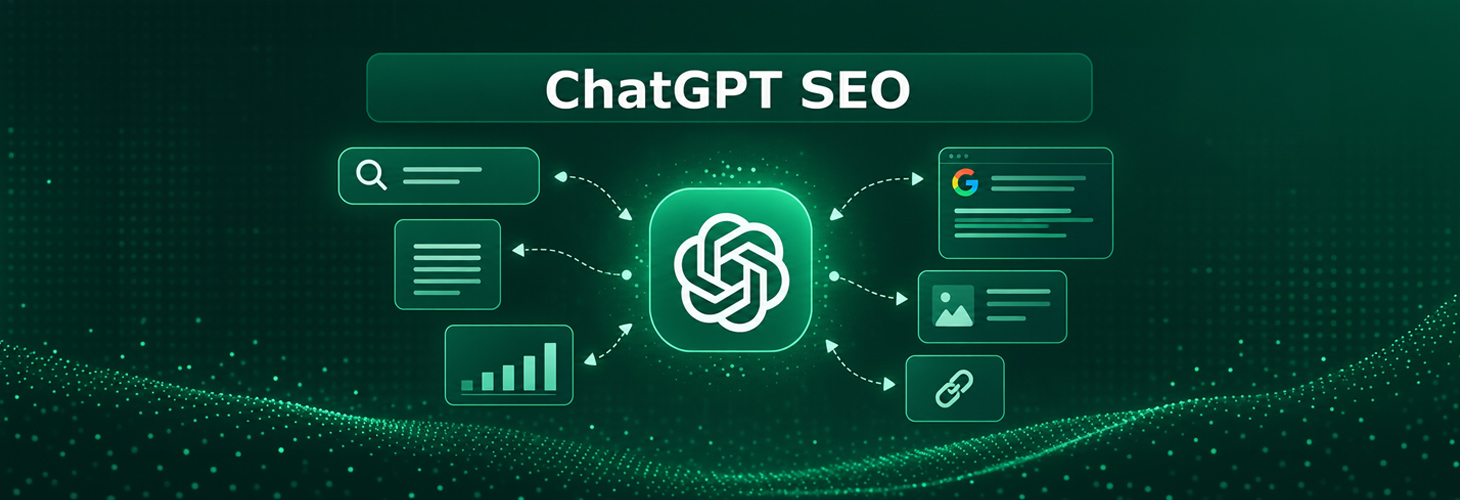
ChatGPT SEO covers all measures that help a website or online store be mentioned, linked or recommended as a product in ChatGPT’s answers. It is a sub-discipline of Generative Engine Optimization, which deals with all AI assistants, and in several respects differs clearly from classic search engine optimisation for Google: different crawlers, a different search index, no fixed ranking and separate routes for product data.
Why ChatGPT matters for online stores
ChatGPT is now used by well over a billion people a week, many of them for purchase decisions. Instead of comparing ten search results, they ask: “Which cordless lawnmower is quiet enough for 300 square metres?” or “Where can I get the raised bed in 200 centimetres by Friday?”. ChatGPT answers such questions with a selection, often with product cards, prices and links to retailers. If you’re missing from this selection, you aren’t found at that moment, however well you rank on Google.
How ChatGPT arrives at its answers
ChatGPT has two sources of knowledge:
| Model knowledge | Web search |
Where from | texts the language model was trained on | pages ChatGPT fetches during the conversation |
Up to date | up to the model’s training cut-off | current |
Source citations | none | yes, with links |
Can be influenced | only in the long term, through the brand’s presence on the web | yes, through content, technology and product data |
Important for | awareness of brand and store | specific recommendations, prices, availability |
For questions about current information, products, prices or providers, ChatGPT usually starts a web search. To do so, the system rewrites the question into one or more search queries, fetches suitable pages from OpenAI’s own index and from external search providers, selects the most helpful sections and writes the answer from them, with source citations. OpenAI fills its own index with the OAI-SearchBot crawler. Bing has been an important source for web search in the past, so good visibility on Bing remains a sensible foundation.
OpenAI’s crawlers
OpenAI uses several crawlers with different tasks. They can be controlled individually in the robots.txt:
Crawler | Task | Consequence of blocking |
OAI-SearchBot | builds the search index for ChatGPT, including for product recommendations | pages no longer appear in ChatGPT’s search answers |
GPTBot | collects content for training future models | no effect on search, but on long-term model knowledge |
ChatGPT-User | fetches pages on a user’s behalf, for example when they share a link | users and agents can’t open the page |
The most important insight: blocking GPTBot to exclude your content from training keeps you visible in ChatGPT search, as long as OAI-SearchBot is allowed. Blocking OAI-SearchBot makes you disappear from the answers. Whether your robots.txt handles this correctly is shown by the robots.txt Checker; ready-made templates for Shopware and Shopify are in the article on robots.txt in the AI era.
Two technical traps are often overlooked. First, some security and CDN services now block AI crawlers by default, regardless of the robots.txt. Second, OpenAI’s crawlers generally don’t execute JavaScript. Content, prices or reviews that are only loaded in the browser are invisible to them.
Is there a ranking in ChatGPT?
Not in the classic sense. There are no fixed positions and no list that looks the same for everyone. Which sources ChatGPT names depends on the exact wording of the question, the conversation so far and the selection of sections. Two similar questions can lead to different sources. ChatGPT SEO is therefore about the probability of being named across many different questions, not about a specific position.
How ChatGPT selects sources
OpenAI doesn’t disclose the exact criteria. But clear patterns emerge from how it works and from observation:
Direct, complete answers: sections that answer a question clearly in a few sentences are cited preferentially. Definitions, comparisons, tables and FAQs are particularly suitable.
Freshness: for questions about products, prices and new developments, current pages win. A visible update date helps.
Corroboration by others: if a store or product is also mentioned in test reports, trade media, review portals and forums, the probability that ChatGPT recommends it increases.
Clarity: clear information about company, brand and products, supplemented by structured data, helps ChatGPT assign information correctly. More on this under entity SEO.
Trust: the same qualities Google summarises under E-E-A-T count here too: recognisable authors, expertise, complete company information.
ChatGPT and online stores
For buying queries, ChatGPT shows products with images, prices, reviews and links to retailers. According to OpenAI, these recommendations are not paid. The data comes together in three ways:
Crawling: OAI-SearchBot reads product pages, including structured product data.
Product feeds: retailers can apply to OpenAI and submit their products directly as a feed. Shopify merchants are connected automatically via Shopify’s Agentic Storefronts. Shopware merchants need their own feed, for example via a feed tool.
Third-party data: reviews, test reports and product data from other sources.
OpenAI withdrew buying directly in the chat in March 2026. Since then, purchases are made in the retailer’s store. The protocol behind it, the Agentic Commerce Protocol, now mainly serves to transmit product data and promotions to ChatGPT. How this relates to Google’s Universal Commerce Protocol is shown in the article on UCP and agentic commerce.
In practice this means: complete product data with GTIN, brand, variants, price and availability, current prices on the page and in the feed, product information in the delivered HTML rather than only via JavaScript, and content that answers typical buying questions. More on feeds in the article on price comparison sites.
Organic recommendations and ChatGPT Ads
Since 24 August 2026, ChatGPT has also shown advertising in Germany, Austria and Switzerland, for users of the free Free and Go plans. The ads appear as labelled cards separate from the answer. Personalised ads are initially not available in the European Economic Area. The answer itself and the product recommendations in it can’t be bought. ChatGPT SEO and ChatGPT Ads therefore relate to each other much like organic search and Google Ads: two separate channels that complement each other.
Measuring ChatGPT SEO
Visits from ChatGPT: ChatGPT adds the parameter utm_source=chatgpt.com to links, and chatgpt.com appears as a referral source in web analytics. This allows visits and revenue from ChatGPT to be evaluated separately.
Mentions in answers: regularly ask a fixed list of typical customer questions and evaluate whether and how the store is named. This is exactly what arboro.PULSE automates for ChatGPT, Claude, Gemini, Copilot and Perplexity.
Technical readability: whether a store is readable for AI crawlers and AI agents is checked by the Agentic Commerce Scanner.
The roadmap for online stores
Allow OAI-SearchBot and ChatGPT-User in robots.txt, firewall and CDN; decide deliberately about GPTBot.
Provide important content, prices and reviews in the delivered HTML.
Maintain complete product data and mark it up with structured data.
Register with Bing Webmaster Tools and submit the sitemap.
Write categories and guides so that they directly answer typical buying questions.
Build mentions outside your own store: test reports, trade media, reviews.
As a Shopware merchant, look into a product feed for ChatGPT; as a Shopify merchant, steer Agentic Storefronts deliberately.
Measure visits from ChatGPT and mentions in answers regularly.
Frequently asked questions
What is the difference between ChatGPT SEO and GEO?
GEO covers optimisation for all AI assistants, i.e. ChatGPT, Claude, Gemini, Copilot and Perplexity. ChatGPT SEO focuses on ChatGPT’s particularities, such as OpenAI’s crawlers and product feeds.
Is good Google SEO enough for ChatGPT?
It is a good foundation, but not sufficient. ChatGPT uses its own crawlers and its own index, and anyone who accidentally blocks OAI-SearchBot is invisible despite good Google rankings.
Should I block GPTBot?
It is a trade-off. Blocking protects content from training future models but has no influence on visibility in ChatGPT search. In the long term, it can mean the model knows the brand less well.
Can you buy your way into ChatGPT recommendations?
No. According to OpenAI, the recommendations in the answers are not paid. Paid placement only exists via ChatGPT Ads, clearly separated from the answer.
Can I sell in ChatGPT?
Purchases are made in your own store. ChatGPT recommends the product and links to the product page.
How quickly does ChatGPT SEO work?
Technical access and product data usually take effect within a few weeks. Mentions and awareness outside the store take longer, but have a lasting effect.
How arboro makes online stores visible in ChatGPT and other AI assistants is described on the page GEO for online stores. Where a store stands today is shown by the AI Readiness Check.