
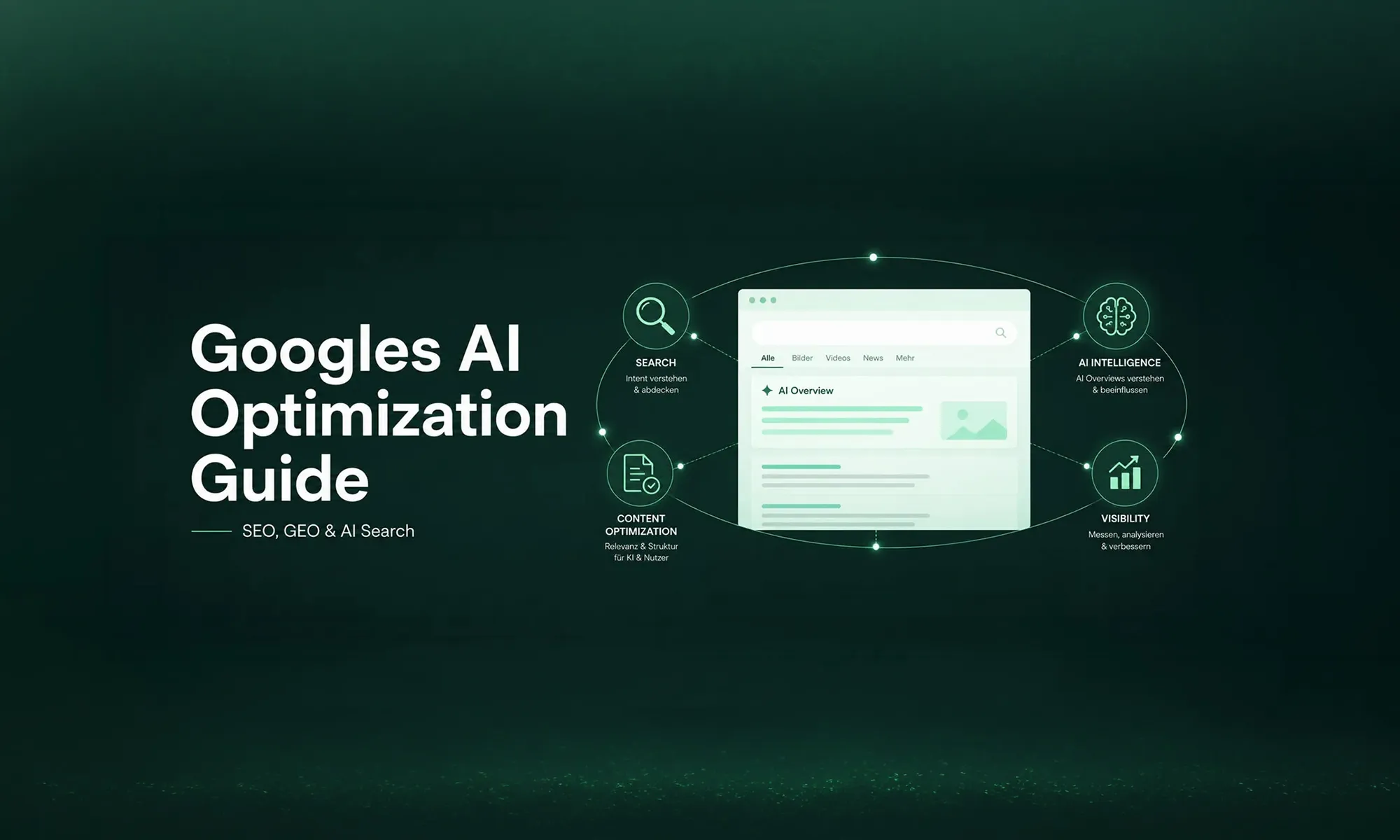
Google’s guide to AI search: what it means for Shopware and Shopify merchants
For a long time, Google said little that was concrete about AI search. While the industry got lost in acronyms such as GEO, AEO and LLMO, questions about AI Overviews and AI Mode remained largely unanswered. On 15 May 2026, Google changed that. With the guide “Optimizing your website for generative AI features on Google Search”, there is for the first time an official, detailed answer to the question that has been on online merchants’ minds since AI Overviews launched: how does my store stay visible when Google formulates the answer itself?
This article puts the guide into context, from the perspective of merchants with a Shopware or Shopify store. What does it say, which myths does Google dispel, what does the guide leave out, and what does it mean concretely for your store?
The key points:
For Google, AI optimisation is still SEO. AI Overviews and AI Mode build on the existing ranking and quality systems. If you are weak in regular search, you will rarely be cited in AI answers.
Google dispels myths: llms.txt files, chopping up content, rewriting for AI and special markup achieve nothing in Google Search.
For stores, the product feed is the real lever. Product answers in AI Mode draw heavily on structured commerce data, above all from Merchant Center.
The guide applies only to Google. ChatGPT, Claude, Perplexity and Copilot work according to their own rules.
Measurement is now possible: Search Console shows performance in generative AI features in a dedicated report.

What Google officially says
The guide sits in the Google Search Central documentation in a dedicated section on generative AI fundamentals. This gives the topic a permanent place alongside the classic SEO starter guide. That alone is a signal: for Google, generative AI is no longer a special case, but part of search.
The core message is deliberately clear. From Google’s point of view, optimising for AI search is optimising for search, so it is still SEO. AI Overviews and AI Mode rely on the same systems that determine the regular results. Technically, this means a page has to be in the index and eligible for snippets to appear in an AI answer at all.
The guide explains two mechanisms in more detail:
Grounding: The AI doesn’t generate its answers solely from the language model’s knowledge, but bases them on current web pages from the search index. The pages that perform well in regular search are therefore also the ones named in AI answers.
Query fan-out: In the background, the system turns one question into several search queries. Asking for a quiet lawnmower for a small garden also triggers searches for noise levels, battery life and comparisons. Visibility therefore comes from the whole topic area, not from a single term.
The recommendations Google derives from this are familiar to experienced SEO teams: original content with a real perspective, clean technology, indexable pages, a good user experience, sensible internal linking, high-quality images and videos. How Google assesses pages overall is described in the entry on Google SEO.
The mythbusting: what Google clears up
The most revealing part of the guide is the one in which Google explicitly declares tactics unnecessary:
llms.txt and other special files: Google Search needs no special files for AI systems and no Markdown versions of pages. Google itself points out, however, that other services may use such files.
Chopping up content: Texts don’t need to be broken into small pieces for an AI to understand them. Google finds the right section even on long pages.
Rewriting for AI: Deliberately rewording content so that every conceivable phrasing of a question appears is unnecessary. The systems understand synonyms and meaning.
Special markup: Structured data isn’t required for generative search, and there is no special schema.org markup for it. It remains useful for rich results in regular search.
Artificial mentions: Google considers deliberately planted mentions in forums and comments ineffective.
These clarifications are valuable because they save money. Especially in the store environment, extensions and apps are sold that generate an llms.txt at the push of a button and promise more visibility in AI search. According to Google itself, this has no effect in Google Search.

What this means for online stores
The guide is written for all websites. For merchants it is worth taking a closer look, because AI search works differently for buying queries than for informational ones. If you ask for a product in AI Mode, you are shown products with price, availability, reviews and retailers. This information doesn’t come from running text, but from structured commerce data, above all from Google Merchant Center.
This leads to an important distinction. According to the guide, special markup isn’t needed to appear in AI answers. But for stores, a complete, correct product feed and clean product data on the page are exactly what becomes visible in product answers: price, delivery time, returns, variants. For online stores, the emphasis therefore shifts from markup to data.
Then there is the next stage. Alongside the guide, Google is building agentic shopping experiences with the Universal Commerce Protocol, in which AI agents don’t just recommend but buy on the customer’s behalf. How stores prepare for this is described in the article on UCP and agentic commerce.
Shopware: what matters now
For Shopware stores, the guide confirms what applies anyway: the fundamentals decide. Typical problem areas that slow down both regular and AI search are:
Indexing: filter and sorting variants that keep Google busy, and variants without a clear canonical rule. Whatever isn’t properly in the index can’t appear in any AI answer either.
Category pages without content: product grids without an introduction and without answers to typical questions give grounding little material.
The feed: products reach Merchant Center via a sales channel of the product comparison type or a feed tool. Incomplete attributes, missing GTINs or differing prices cost visibility in product answers.
Agentic commerce: for agents that are meant to buy in the store, there is the official Agentic Commerce extension with UCP. It isn’t needed for the guide, but it is the next logical step.
More on the technical foundations under Shopware SEO.
Shopify: what matters now
Shopify comes with many fundamentals out of the box. The stumbling blocks lie elsewhere:
Content that only appears via JavaScript: apps for reviews, product details or questions and answers often load their content afterwards. Whatever Google doesn’t reliably see when rendering is also missing from grounding.
llms.txt apps: they promise AI visibility, but according to Google they achieve nothing in Google Search. Their benefit for other systems is open.
The route into Merchant Center: It connects the store to product answers in Search and AI Mode. The Google & YouTube app is only enough for a store with one language and one domain. If you run several languages or domains, such as a German and an English store, you need a feed tool such as ChannelPilot. Missing product identifiers and warnings in Merchant Center are the most common causes of weak visibility.
Agentic Storefronts: Shopify now serves products to AI assistants by default. The guide doesn’t cover this, but for Shopify merchants it is part of the same task.
More on the platform’s peculiarities under Shopify SEO.
What the guide doesn’t say: four blind spots
The guide is useful, but it is one company’s view of its own product. Merchants should keep four points in mind.
First: it is only about Google. ChatGPT, Claude, Perplexity and Copilot use their own crawlers, their own search indexes and their own rules for which sources they name. Buying advice increasingly happens there too. A strategy that targets only Google leaves this part untouched. This is exactly what Generative Engine Optimization exists for as a discipline of its own.
Second: what is unnecessary for Google can be useful elsewhere. Google itself mentions that other services may use files such as llms.txt. Whether a store allows the crawlers of OpenAI, Anthropic or Perplexity is also decided by the robots.txt. How this works is shown in the article on robots.txt for Shopware and Shopify. Which of these crawlers your store currently allows is shown by the free robots.txt Checker.
Third: Google’s statements are snapshots. E-A-T became E-E-A-T, the helpful content system was absorbed into the core systems in 2024, and the US antitrust case showed that user interactions feed into ranking systems. The official guides are the best available source, but not a verdict for all time. Where SEO knowledge comes from and how reliable the sources are is described in the entry on optimising for search engines.
Fourth: self-interest. Google has an interest in merchants staying within its own ecosystem, with Merchant Center, Business Profile and its own shopping experiences. That makes sense, but it is also a business model. The statement that AI optimisation is simply SEO also secures Google’s interpretive authority over the topic.

Why GEO remains a task of its own
Much of the guide matches what good GEO work is about: a strong foundation, clean technology, original content. If you take that seriously, you have done a large part of the work. For online stores it still isn’t quite enough, for three reasons.
The systems differ. ChatGPT, Claude, Gemini and Perplexity select sources according to their own logic, and a store can be named frequently in one system and not at all in another. Customers ask differently. Anyone talking to an assistant describes their situation, asks follow-up questions and compares. Content that answers such questions is a competence of its own. And agents buy. For the step from recommendation to purchase, a store needs machine-readable product data and interfaces such as UCP, which hardly feature in the guide.
What merchants should do now
Open the report in Search Console. Google now shows performance in generative AI features in a dedicated report. This is the first look at whether and how your store appears there.
Check the fundamentals. Indexing, categories, loading time, internal linking. This is where the best ratio of effort to impact lies. How to check whether pages are in the index is shown in the article on Google indexing.
Get the product feed in order. Complete attributes, GTINs, correct prices and shipping costs in Merchant Center. More on this in the article on price comparison sites.
Show your own perspective. Buying advice, experience and real expertise in the sense of E-E-A-T are what an AI can’t generate itself.
Measure beyond Google. How often your store is named in ChatGPT, Claude, Gemini, Copilot and Perplexity is shown by arboro.PULSE.
Prepare for agents. Whether your store is technically readable for AI agents is checked by the free Agentic Commerce Scanner.
How arboro supports you
The guide shows that AI visibility doesn’t come from tricks, but from clean work on technology, content and data. arboro combines exactly these three areas in one team: store development for Shopware and Shopify, SEO and GEO, and product data and feeds. The result is a strategy that works in Google Search and beyond, in the answers of ChatGPT, Claude, Gemini, Copilot and Perplexity. Where your store stands today is shown by the AI Readiness Check. What the work on your AI visibility looks like is described on GEO for online stores.
Sources:
Author

René Härer
Head of Content
René has been responsible for our editorial department for more than ten years, and with it the content of all client projects in online marketing. During this time, he has continuously managed well over 70 SEO projects and established himself as an expert in content strategies. With his training as an agile leader and certified manager for AI transformation, he combines strategic thinking with operational implementation. As a graduate historian, he brings a source-critical perspective to every new platform statement — a quality that is more valuable than ever in times of AI hype and revised search engine guidelines. What he particularly values about his profession is the combination of research, strategy, and honest consulting for customers seeking orientation in an increasingly complex digital world.